Involuntary Psychiatric Admission in South Korea: A Procedural Guide
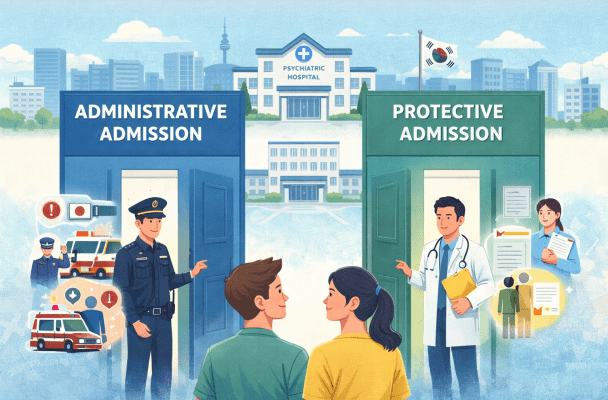
This guide explains Administrative Admission and Protective Admission
under Korean mental health law, based on official procedures of the
National Center for Mental Health.It is written for non-lawyers and non-medical readers.
1. The Two Main Types of Involuntary Admission in South Korea
🔵 Administrative Admission
(행정입원)
- Initiated by local government authorities
- Used when no guardian is available or urgent public intervention is needed
- Often involves police and public mental health systems
🟢 Protective Admission
(보호입원)
- Initiated by family members or legal guardians
- Requires consent from two qualified guardians
- Focuses on family responsibility and protection
2. Administrative Admission (행정입원)
When is it used?
Administrative admission is used when:
- A person shows severe mental symptoms
- There is a risk of harm to self or others
- The person cannot make informed decisions
- No guardian is available, or immediate action is required
Typical situations:
- A foreigner living alone in Korea
- A person found in public places showing dangerous behavior
- Emergency cases involving police intervention
Administrative Admission Flow
[Person Identified]
↓
[Police or Doctor Requests Mental Health Evaluation]
↓
[Psychiatric Evaluation (Face-to-face)]
↓
[Local Government (Mayor/District Head) Reviews]
↓
[Decision for Administrative Admission]
↓
[Admission to Designated Psychiatric Hospital]
Key Points
- Police can request evaluation if they find the person
- A psychiatric specialist must examine the person, in person
- The local government makes the legal admission decision
- Initially used for diagnosis, then may extend to treatment
⏱ Time-sensitive
- Emergency admission may occur first
- Must be converted to administrative admission within 72 hours
3. Protective Admission (보호입원)
When is it used?
Protective admission is used when:
- The patient has family or legal guardians
- Two guardians agree that hospitalization is necessary
- The patient refuses treatment or lacks insight
- Family seeks protection and treatment through legal means
Who Can Be a Guardian?
Under Korean law, guardians may include:
- Spouse
- Parents
- Adult children
- Siblings
- Relatives living together
(specific order and conditions apply)
⚠ For foreigners, documents proving family relationships may require apostille or consular verification.
Protective Admission Flow
[Psychiatric Face-to-face Diagnosis]
↓
[Hospital Director Issues Admission Order]
↓
[Two Guardians Submit Admission Request]
↓
[Patient Admitted (Protective Admission)]
↓
[Admission Review Committee Review]
↓
[Discharge OR Continued Admission (up to 3 months)]
Key Points
- Requires two guardian consents
- A second psychiatric evaluation is mandatory
- Admission is reviewed by an independent committee
- Continued admission requires periodic reassessment
⏱ Timeframe
- Hospital must report admission within 3 days
- Review determines discharge or continuation within 3 months
4. Administrative vs Protective Admission (Comparison)
| Category | Administrative Admission | Protective Admission |
|---|---|---|
| Initiated by | Local government authority | Family members or legal guardians |
| Police involvement | Common | Rare |
| Guardian required | No | Yes (two guardians) |
| Suitable for foreigners | Very common | Depends on family presence |
| Emergency use | Yes | Limited |
| Legal authority | Mayor / District Head | Hospital Director + Guardians |
| Review system | Government and medical review | Admission Review Committee |
5. Important Notes for Foreign Residents
- Language barriers do not prevent admission
- Lack of family in Korea often leads to administrative admission
- Identification may use:
- Passport
- Alien Registration Card
- Embassy assistance (if needed)
- Human rights protections apply equally to foreigners
6. In Emergency Situations
If the situation is very urgent:
- Emergency admission may occur first
- Formal administrative procedures follow shortly after
- This ensures immediate safety first, paperwork second
Involuntary Admission: Final Thought
Think of it this way:
- Administrative Admission = Public safety net
- Protective Admission = Family-led protection
응급입원 의뢰서 [예시] – 행정입원의 경우
Emergency Admission Request Form (Sample) – in case of administrative admission
※ 본 문서는 제도 설명을 위한 가상 예시이며, 실제 사례가 아닙니다.
※ This document is a fictional sample for informational purposes only.
—
■ 신청인
Applicant
성명 / Name: 김민수 (Min-su Kim)
전화번호 / Phone: +82-10-1234-5678
주소 / Address:
서울특별시 ○○○ 경찰서 ○○○과
○○○ Police Station, ○○○ Division, Seoul
—
■ 피신청인 (환자)
Person Subject to Emergency Admission
성명 / Name: Michael SCOTT
국적 / Nationality: Republic of Bora Bora
여권번호 / Passport No.: AB1234567
주소 / Address: 불상 (Unknown)
현재 소재지 / Current Whereabouts: 불상 (Unknown)
—
■ 증상 및 행동에 대한 개요
Summary of Symptoms and Behavior
대상자는 최근 극도의 불안, 혼란, 망상적 사고를 보이고 있으며, 자신 또는 타인에게 위해를 가할 가능성이 높다고 판단됨.
The individual has recently exhibited severe anxiety, confusion, and delusional thinking, and is assessed to pose a high risk of harm to themselves or others.
의사소통이 원활하지 않고 현실 판단 능력이 현저히 저하되어 있으며, 자발적으로 치료에 동의하기 어려운 상태임.
Communication is significantly impaired, reality testing is markedly reduced, and voluntary consent to treatment is deemed unlikely.
이에 따라 「정신건강증진 및 정신질환자 복지서비스 지원에 관한 법률」에 근거하여 응급입원이 필요하다고 판단됨.
Accordingly, emergency hospitalization is considered necessary pursuant to the Mental Health Promotion and Welfare Act of the Republic of Korea.
—
■ 보호의무자 또는 보호자
Legal Guardian or Family Member
(※ 확인 불가 시 공란 / Leave blank if unavailable)
성명 / Name: —
환자와의 관계 / Relationship: —
전화번호 / Phone: —
—
■ 응급입원 동의 의사
Medical Professional Consenting to Emergency Admission
접수번호 / Reference No.: 123456
소속기관 / Affiliation: ○○ Mental Health Center
성명 / Name: 이지은 (Ji-eun Lee)
서명 / Signature: (omitted)
—
■ 응급입원 의뢰 경찰관
Police Officer Requesting Emergency Admission
직위 / Rank: Inspector
소속 / Affiliation: ○○ Police Station, ○○ Substation
성명 / Name: 김민수 (Min-su Kim)
서명 / Signature: (omitted)
—
본인은 상기 사유에 따라 응급입원을 의뢰합니다.
I hereby request emergency hospitalization for the reasons stated above.
신청일 / Date: March 3, 2024
신청인 성명 / Applicant Name: 김민수 (Min-su Kim)
서명 / Signature: (omitted)
—
정신의료기관의 장 귀하
To the Director of the Psychiatric Medical Institution
 KLAWGURU.COM