The Standards for Distinguishing Assault (폭행) from Bodily Injury (상해) under Korean Law
1. The Difference in Protected Legal Interest and Basic Concept
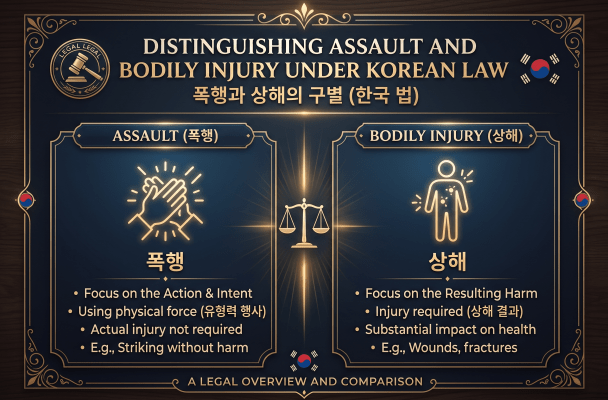
Assault (폭행) and bodily injury (상해) are both offenses that infringe a person’s body, and they share the protected legal interest of the inviolability of the body; but they differ essentially in the content and degree of that protection.
- Assault: the protected legal interest is the soundness of the body (the integrity of the body), and it is a conduct offense established by the exercise of physical force against a person’s body itself (Criminal Act, Article 260(1)).
- Bodily injury: an offense that infringes the content of the body’s integrity, and it is a result offense that requires the occurrence of the result of injury (Criminal Act, Article 257(1)). The fact that there is a provision punishing attempts also stems from this character.
2. The Key Distinguishing Standards in the Elements of the Offense
A. The meaning of “assault”
The precedents consistently state that the “assault” referred to in the offense of assault means the exercise of physical force that causes physical or mental pain to a person’s body. It is enough that there be an exercise of physical force against the body, and the occurrence of a separate result of bodily infringement is not required.
B. The meaning of “injury”
The Supreme Court has held on the “injury” in the offense of bodily injury as follows.
The injury in the offense of bodily injury means damaging the integrity of the victim’s body or causing an impairment to physiological function. Where the wound accompanying an assault is so extremely minor as to be of the degree of a wound or discomfort that could ordinarily arise in everyday life even without the assault, and it heals naturally without any need for treatment and causes no hindrance to everyday life, it cannot be regarded as the injury of the offense of bodily injury. (Supreme Court, Dec. 4, 2025, 2025do11886; Supreme Court, Nov. 13, 2008, 2007do9794)
That is, the standards for judging whether an injury exists are the following two:
| Category | Content |
|---|---|
| Affirmative standard | Damage to the integrity of the body, or causing an impairment to physiological function |
| Negative standard | An extremely minor wound of a degree that could ordinarily arise in everyday life even without the assault—needing no treatment, healing naturally, and causing no hindrance to everyday life |
C. How to judge whether an injury exists
Whether an injury exists is to be judged not objectively and uniformly, but individually and concretely, by reference to the victim’s concrete physical and mental state—age, sex, physique, and the like (Supreme Court, Dec. 4, 2025, 2025do11886).
3. Distinction by the Content of Intent
Assault and bodily injury are also distinguished by the content of the actor’s intent.
- Where the actor committed the act with intent to injure from the outset but it went no further than assault → the offense of attempted bodily injury is established (Criminal Act, Article 257(3)).
- Where there was only intent to assault but the result of injury arose → the offense of assault causing bodily injury is established (Criminal Act, Article 262).
Because there is no provision punishing attempts at the offense of assault, this distinction is very important in practice.
4. Statutory Penalties and Other Differences
| Category | Bodily injury (Criminal Act, Article 257(1)) | Assault (Criminal Act, Article 260(1)) |
|---|---|---|
| Statutory penalty | Up to 7 years’ imprisonment, up to 10 years’ suspension of qualification, or a fine of up to KRW 10 million | Up to 2 years’ imprisonment, a fine of up to KRW 5 million, detention, or a minor fine |
| Punishment of attempts | Yes (Article 257(3)) | No |
| Offense not prosecutable against the victim’s will | No | Yes (Article 260(3)) |
5. Distinction Under the Sentencing Guidelines
Under the sentencing guidelines, a minor injury means an injury with a treatment period of 2 weeks or less, where the injured area is partial, it does not greatly hinder everyday life, and it does not require special medical treatment such as suturing surgery; a serious injury means, by reference to a treatment period of about 4 to 5 weeks or more, a case in which an aftereffect or severe disfigurement remains, the injury is to a dangerous area, or further injury is anticipated. For ordinary bodily injury, the basic range is 4 months to 1 year 6 months’ imprisonment; for ordinary assault, the basic range is 2 to 10 months’ imprisonment.
6. Practical Points
In a case where a minor wound is at issue, the court does not recognize an injury on the strength of the existence of a medical injury certificate alone, but judges whether an injury exists by considering comprehensively: (1) the circumstances and degree of the assault; (2) the need for treatment and whether treatment was actually received; (3) whether everyday life was hindered; and (4) the victim’s concrete physical state (see Daegu District Court, May 11, 2018, 2017godan4405; Seoul Western District Court, Feb. 1, 2018, 2017gojeong917, etc.). Where an injury is not recognized, charging the offense of assault within the scope of the same charged facts is the general manner of handling in practice.
Thank you for reading!

