South Korea Abolishes the Prosecutors’ Office on October 2: Background and What Changes
Key takeaways
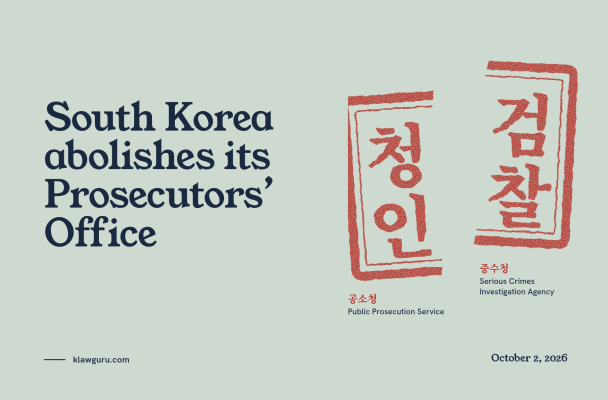
- Starting October 2, 2026, South Korea’s Prosecutors’ Office (Geomchalcheong) will be abolished.
- Its duties will be split between two new bodies:
- The Public Prosecution Service (Gongsocheong), under the Ministry of Justice, which will handle indictments.
- The Serious Crimes Investigation Agency (Jungsucheong), under the Ministry of the Interior and Safety, which will investigate major crimes (only).
- Prosecutors will no longer be able to investigate at all. They can only request that the police carry out supplementary investigations.
1. Background: How Did We Get Here?
The core issue
- Korean prosecutors held both investigative and indictment powers, which made them unusually powerful by international standards.
- Reform advocates argued that when one body both investigates and indicts, nothing checks it internally. In their view, this invited politically targeted investigations or selectively lenient prosecutions.
- The guiding principle behind the reform is known as the “separation of investigation and indictment.”
<Timeline>
- 2021 (Moon Jae-in administration)
- Prosecutors lost the power to direct police investigations.
- Police gained authority to close cases themselves by deciding not to refer them to prosecutors.
- Prosecutors’ direct investigations were limited to certain categories of crime.
- This is when case backlogs began to build.
- September 2025: The National Assembly passed an amendment to the Government Organization Act abolishing the Prosecutors’ Office and creating the Serious Crimes Investigation Agency and the Public Prosecution Service.
- March 2026: The Public Prosecution Service Act was enacted, removing prosecutors’ power to investigate crimes and their authority to direct special judicial police officers, both of which had existed under the old Prosecutors’ Office Act.
- July 31, 2026: An amendment to the Criminal Procedure Act fully abolishing prosecutors’ supplementary investigation powers passed with 175 of 178 members present voting in favor. The People Power Party boycotted the vote after a filibuster.
- Result: Prosecutors’ investigative powers, which had existed since the Criminal Procedure Act was enacted in 1954, disappear, and investigation and indictment become fully separate.
2. What Changes: The New System
Who does what (before → after October 2)
- Indictment: Prosecutors’ Office → Public Prosecution Service (a three-tier structure of national, regional, and district offices)
- Serious crime investigation: Direct investigation by prosecutors, plus the police → Serious Crimes Investigation Agency
- General crime investigation: Police, with prosecutors able to investigate further → Police (National Office of Investigation) only
- Supplementary investigation by prosecutors: Allowed → Not allowed. Prosecutors may only request it from the police.
Public Prosecution Service (공소청)
- It will have no investigative function and will handle only filing and maintaining prosecutions.
- Its authority to direct and supervise special judicial police officers has been abolished, and a new clause prohibits abuse of authority.
- The prosecutor’s role shifts from “investigator” to “prosecution officer.” Prosecutors will review whether evidence gathered by investigative agencies is lawful and sufficient, then decide whether to indict.
Serious Crimes Investigation Agency (중수청)
- It will investigate six major crime categories: corruption, economic crimes, defense industry crimes, narcotics, insurrection and treason, and cybercrime.
- Its staff will include people from both the prosecution and the police.
Deadlines for supplementary investigations
- Once police receive a request, they must finish the supplementary investigation within one month, with a possible one-month extension.
Victims’ right to object
- If police decide not to refer a case, complainants, victims, and those who filed criminal accusations can file an objection.
New grounds for courts to dismiss prosecutions
- Courts may dismiss a prosecution if it rests on seriously unlawful investigation or clearly exceeds the prosecutor’s discretion.
Tighter controls on prosecutors
- “Dismissal” is now listed as a disciplinary sanction, so prosecutors can be removed without impeachment proceedings.
- According to some, the new law also tightens the rules on political neutrality. Social media posts or media interviews that happen to align with, or oppose, a particular party or politician could expose a prosecutor to discipline.
Admissibility of statements taken by prosecutors
- The amended Criminal Procedure Act states that material obtained by prosecutors through interviews or fact-checking has no evidentiary value.
- There does seem to be an exception for sexual crime victims’ statements.
3. Concerns Raised from the Front Lines
The Serious Crimes Investigation Agency isn’t ready
- Many point out that the agency lacks basic infrastructure: desks, chairs, buildings, and IT systems.
- One regional office is reportedly still undergoing interior demolition work.
- Some compare the agency – in its current state – to a car with its doors open but parked: it exists but can’t move. She expects this to last at least until year-end.
- News reports confirm that a month before launch, the Public Prosecution Service’s organizational structure and staffing numbers for prosecutors and investigators had still not been finalized.
Staff shortages and a missing “middle”
- Many prosecutors have resigned or moved to the judiciary, so actual headcount is already below the authorized number.
- The government has nonetheless announced plans to cut the authorized number of prosecutors, reasoning that investigation duties are gone.
- Mid-career prosecutors, with roughly 5 to 10 years of experience, have largely been seconded to special counsel teams and joint investigation units. Front-line offices are left mostly with senior managers and junior prosecutors with under five years of experience.
The workload won’t actually shrink
- The government’s logic: investigations are gone, so the work should be lighter.
- Rebuttal:
- Direct supplementary investigations were always a small share of prosecutors’ work.
- Most of their time went to reviewing files, requesting supplementary investigations, and reviewing cases police chose not to refer.
- Now a task she could finish herself in an hour must be explained in writing to the police.
- When the file comes back months later, she has to reread it from scratch. If the request was misunderstood, it has to go back again.
- The work doesn’t disappear. It just becomes less efficient.
Worsening case backlogs
- Some prosecutors currently have about 500 cases pending.
- Most prosecutors can close about 200 a month, but roughly the same number keeps coming in, so the pile never shrinks.
- Each case involves at least one victim and one suspect, and some involve more than 30 suspects. Many people are left waiting anxiously for outcomes.
Statute of limitations risk
- Within the prosecution, letting a statute of limitations expire is a disciplinary matter, so prosecutors prioritize those cases.
- Some prosecutors argue that when an urgent case would be sent to the police, the police would not treat it with the same seriousness or urgency.
- The worry is that cases will expire while bouncing between agencies.
Trials bogged down by jurisdictional disputes
- Experts expect cunning/smart defense lawyers to argue the following:
- A prosecutor’s interview was effectively an investigation conducted without legal authority.
- Evidence from supplementary investigations based on that interview is therefore “fruit of the poisonous tree.”
- The new grounds for dismissing prosecutions may also become a point of contention.
- Trials risk shifting focus from “Is the defendant guilty?” to “Did the agency have investigative authority?”
- News reports likewise note concerns that criminal trials may become longer under the new system.
Confusion for the public about where to report
- Previously, you simply filed a complaint with the prosecution or the police.
- Now you may need to figure out whether your case belongs with the police, the Serious Crimes Investigation Agency, or the Corruption Investigation Office for High-ranking Officials.
- Courts have ruled that some cases handled by that office or by special counsels fell outside those bodies’ jurisdiction, even though legal professionals were running them. Ordinary citizens will find the distinctions even harder.
No one at the helm
- Currently, the Minister of Justice, Prosecutor General, head of the Serious Crimes Investigation Agency, and Commissioner General of the Police were all either vacant or held by acting officials.
- The deputy prosecutor general post was also vacant for a time, leaving an “acting-acting” arrangement.
- Critics see a leadership vacuum during what amounts to a complete rewrite of the criminal justice system.
Sidenote: The controversy over withdrawing indictments (공소취소)
- Some inside and outside the prosecution suspect that the recent appointment of a new deputy prosecutor general, who is also acting prosecutor general, is groundwork for withdrawing indictments in cases involving President Lee Jae-myung.
- The reality: Prosecutors rarely withdraw an indictment except maybe in minor cases that cannot be prosecuted once the victim no longer wants punishment.
4. The Supporters’ Case
- Supporters see the reform as a historic step toward placing prosecutorial power under democratic control.
- Democratic Party lawmaker Park Jie-won described the new structure this way: police take responsibility for investigations, while prosecutors, who decide whether to indict, identify specific gaps and verify that they have been addressed.
- Concerns raised in the public have been addressed in the legislation:
- The one-to-two-month deadline on supplementary investigations is designed to stop cases from bouncing between agencies.
- The expanded right to object to non-referral decisions is presented as a victim-protection measure.
- An exception appears to have been made for the admissibility of sexual crime victims’ statements.
- Opponents are sharply critical. People Power Party floor leader Jeong Jeom-sik called it the end of the rule of law, warning that the vulnerable would lose legal protection while the powerful escape legal scrutiny.
- The reform’s real-world impact will show up after implementation, in measures such as case processing times, the number of cases that expire, and trial lengths. For now, both sides’ claims are largely predictions.
5. What This Means for Ordinary People
- Expect delays. Case processing will likely slow in the short term, especially for crimes under the new agency’s jurisdiction until it is fully operational.
- Check jurisdiction first. Before filing a complaint, you may need to confirm which agency handles your type of case.
- Use your right to object. If the police decide not to refer your case, consider filing an objection.
- Get legal help early. Some experts warn that South Korea is entering an era of “privatized justice.” Having a lawyer involved from the start matters more than ever.
Thank you for reading.

