Procedure for the Recommendation and Appointment of Supreme Court Justices in South Korea
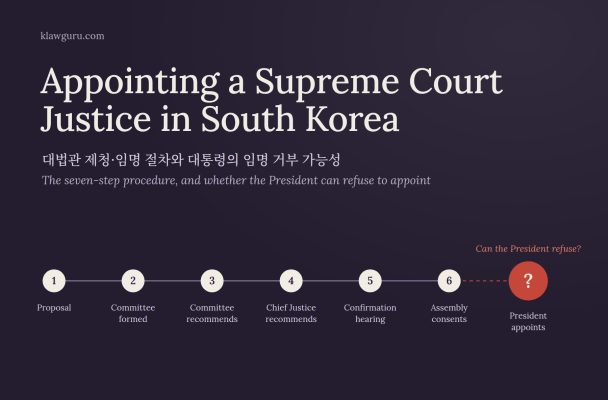
1. Constitutional Basis
Article 104(2) of the Constitution provides that “The Justices of the Supreme Court shall be appointed by the President on the recommendation of the Chief Justice and with the consent of the National Assembly.” Accordingly, the appointment of a Supreme Court Justice follows a three-stage procedure: (1) recommendation by the Chief Justice, (2) consent of the National Assembly, and (3) appointment by the President.
The consent requirement confers democratic legitimacy on members of the highest court, who are not directly elected by the people, through the consent of the directly elected National Assembly. It also serves to verify the candidate’s fitness to serve as a Supreme Court Justice and to check the President’s power of appointment.
2. Number of Justices and Eligibility
A. Number of Justices
The Supreme Court consists of 14 Justices, including the Chief Justice (Court Organization Act, Article 4(2)).
B. Eligibility
The Chief Justice and Supreme Court Justices are appointed from among persons aged 45 or older who have held one or more of the following positions for a total of at least 20 years (Court Organization Act, Article 42(1)).
| Subparagraph | Qualification |
|---|---|
| 1 | Judge, prosecutor, or attorney |
| 2 | A person qualified as an attorney who has been engaged in legal affairs at a state agency, local government, public institution, or other corporation |
| 3 | A person qualified as an attorney who has served as an assistant professor or higher in law at an accredited university |
Where a person has held two or more of these positions, the years of service are aggregated (Court Organization Act, Article 42(3)).
3. Recommendation of Candidates by the Supreme Court Justice Candidate Recommendation Committee
A. Legal Basis and Function
A Supreme Court Justice Candidate Recommendation Committee (the “Recommendation Committee”) is established within the Supreme Court to recommend candidates whom the Chief Justice will recommend for appointment (Court Organization Act, Article 41-2(1)). The Recommendation Committee advises the Chief Justice on the selection of persons to be recommended for appointment under Article 104(2) of the Constitution by recommending candidates for that purpose (Rules on the Supreme Court Justice Candidate Recommendation Committee, Article 2).
B. Composition
Each time the Chief Justice is to recommend a candidate for appointment, a Recommendation Committee of 10 members, including one chairperson, is formed. The Chief Justice appoints or commissions the following persons as members (Court Organization Act, Article 41-2(2) and (3)).
| Subparagraph | Member |
|---|---|
| 1 | The most senior Supreme Court Justice |
| 2 | The Minister of National Court Administration |
| 3 | The Minister of Justice |
| 4 | The President of the Korean Bar Association |
| 5 | The President of the Korea Law Professors Association (an incorporated association) |
| 6 | The Chairperson of the Korean Association of Law Schools (an incorporated association) |
| 7 | One judge who is not a Supreme Court Justice |
| 8 | Three persons of learning and good repute with extensive experience in various professional fields who are not qualified as attorneys (at least one of whom must be a woman) |
The chairperson is appointed or commissioned by the Chief Justice from among the members (Court Organization Act, Article 41-2(4)).
C. Convening and Resolutions
The chairperson convenes the Recommendation Committee at the request of the Chief Justice or of at least one-third of the members, or when the chairperson deems it necessary. Resolutions require the affirmative vote of a majority of all members (Court Organization Act, Article 41-2(5)).
D. Procedure for Proposing Candidates
Any individual, corporation, or organization may, through the Minister of National Court Administration, propose to the Chief Justice in writing (excluding facsimile or email) a person considered suitable for recommendation for appointment as a Supreme Court Justice, or submit other opinions on the recommendation. The same applies when a committee member proposes a candidate. A proposal must state the candidate’s key personal particulars, such as education and career, together with the reasons for the proposal, and must be made in a non-public manner (Rules on the Supreme Court Justice Candidate Recommendation Committee, Article 6).
E. Number of Candidates Recommended and Deference to the Recommendation
The Recommendation Committee must recommend at least three times as many candidates as the number of Justices to be recommended for appointment (where two or more Justices are to be recommended, this applies to each) (Court Organization Act, Article 41-2(6)). When recommending candidates for appointment, the Chief Justice must respect the Recommendation Committee’s recommendation (Court Organization Act, Article 41-2(7)).
Once the Recommendation Committee has recommended its candidates, it is deemed dissolved (Court Organization Act, Article 41-2(8)).
F. Legal Nature of the Recommendation Committee
The Constitutional Court held that the formation of the Supreme Court Justice Appointment Recommendation Advisory Committee is an internal procedure preceding the exercise of governmental power, undertaken to gather opinions from various sectors of society for the Chief Justice’s constitutional power to recommend Justices for appointment, and therefore does not constitute “the exercise or non-exercise of governmental power” within the meaning of Article 68(1) of the Constitutional Court Act (Constitutional Court Decision 2005Hun-Ma33, February 1, 2005).
4. Recommendation by the Chief Justice
Following the Recommendation Committee’s recommendation, the Chief Justice recommends a candidate to the President for appointment. The power to recommend Supreme Court Justices for appointment belongs exclusively to the Chief Justice (Constitutional Court Decision 2005Hun-Ma33, February 1, 2005).
By convention, the Chief Justice has recommended a single candidate for each vacancy, which has drawn criticism that the Chief Justice effectively controls the appointment of Supreme Court Justices. Because the Constitution provides no mechanism for checking the Chief Justice’s recommendation, the Chief Justice may recommend candidates at his or her discretion, and to date there has never been a case in which the National Assembly or the President has rejected a Chief Justice’s recommendation.
5. Confirmation Hearing and Consent by the National Assembly
A. Confirmation Hearing
The National Assembly holds a confirmation hearing on the Supreme Court Justice candidate under the Personnel Hearing Act. A Special Committee on Confirmation Hearings is formed to review consent motions and conduct confirmation hearings for the Chief Justice and Supreme Court Justices.
B. Consent to Appointment
The National Assembly holds the power to consent to the President’s appointment of Supreme Court Justices (Constitution, Article 104(2)). Consent is resolved with a majority of all members present and the concurrent vote of a majority of the members present.
In practice, even where the confirmation hearing report is not adopted, a candidate may be appointed as a Supreme Court Justice if the President submits a request for consent to the National Assembly and the consent motion passes in the plenary session (2019Gohap176 (consolidated), February 5, 2024).
6. Appointment by the President
After obtaining the consent of the National Assembly, the President appoints the Supreme Court Justice (Court Organization Act, Article 41(2)). The appointment procedures for both the Chief Justice and Supreme Court Justices are set out in the Constitution, and both are appointed by the President with the consent of the National Assembly. The only difference is that Supreme Court Justices additionally require the Chief Justice’s recommendation.
7. Democratic Legitimacy of the Appointment Procedure
Because Supreme Court Justices are appointed by the President with the consent of the National Assembly, both the legislative and executive branches are involved in the appointment process. This is a procedural difference arising from the step-by-step process through which judges, unlike directly elected National Assembly members and the President, receive democratic legitimacy indirectly. It does not reflect any qualitative difference between the Chief Justice or Supreme Court Justices and other judges with respect to political neutrality or judicial independence (Constitutional Court Decision 2021Hun-Ma460, July 18, 2024).
8. Summary of the Overall Procedure
| Stage | Description | Legal Basis |
|---|---|---|
| (1) Proposal | Individuals, corporations, or organizations propose candidates in writing through the Minister of National Court Administration | Rules on the Supreme Court Justice Candidate Recommendation Committee, Art. 6 |
| (2) Formation of Recommendation Committee | A 10-member committee is formed each time the Chief Justice makes a recommendation | Court Organization Act, Art. 41-2(2) |
| (3) Recommendation of candidates | At least three times as many candidates as Justices to be recommended; committee dissolved thereafter | Court Organization Act, Art. 41-2(6) and (8) |
| (4) Recommendation by the Chief Justice | Recommendation to the President, respecting the committee’s recommendation (an exclusive power) | Constitution, Art. 104(2); Court Organization Act, Art. 41-2(7) |
| (5) Confirmation hearing | Hearing held by the National Assembly’s Special Committee on Confirmation Hearings | Personnel Hearing Act |
| (6) National Assembly consent | Consent resolved in a plenary session | Constitution, Art. 104(2) |
| (7) Presidential appointment | Final appointment by the President after National Assembly consent | Court Organization Act, Art. 41(2) |
[FYI] The President’s Ability to Reject a Recommendation for Appointment of a Supreme Court Justice and to Request a New Recommendation
1. Review of Constitutional and Statutory Provisions
Article 104(2) of the Constitution provides only that “The Justices of the Supreme Court shall be appointed by the President on the recommendation of the Chief Justice and with the consent of the National Assembly.” It contains no express provision on whether the President may reject a recommendation or request a new one (Constitution of the Republic of Korea, Article 104(2)). Article 41(2) of the Court Organization Act is likewise silent on this point (Court Organization Act, Article 41(2)).
2. Nature of the Chief Justice’s Power of Recommendation
The Constitutional Court expressly held that “since Article 104(2) of the Constitution provides that ‘The Justices of the Supreme Court shall be appointed by the President on the recommendation of the Chief Justice and with the consent of the National Assembly,’ the recommendation of Supreme Court Justices for appointment falls within the exclusive power of the Chief Justice” (Constitutional Court Decision 2005Hun-Ma33, February 1, 2005).
Given that the power of recommendation is recognized as an exclusive power of the Chief Justice, there is strong reason to regard any refusal by the President of the recommendation itself, or any demand that a particular person be recommended, as an infringement of the Chief Justice’s exclusive constitutional power.
3. Academic Debate on the President’s Ability to Refuse Appointment
Because the constitutional text provides that the President “shall appoint” after obtaining the consent of the National Assembly, the question arises whether the appointment is a mandatory (non-discretionary) act or a discretionary act. Based solely on the reference materials provided, it is difficult to identify any case in which the Supreme Court or the Constitutional Court has squarely ruled on this issue. Scholars, however, have advanced the following arguments.
A. View That Refusal of Appointment Is Not Permitted (Majority View)
Under this view, because the Chief Justice’s power of recommendation is recognized as exclusive, and the candidate has also obtained the consent of the National Assembly, the President’s appointment is mandatory in nature. Proponents argue that a presidential refusal to appoint, or a request for a new recommendation, would constitute improper interference by the executive in the composition of the judiciary, contrary to the principle of separation of powers and the independence of the judiciary.
B. View That Refusal of Appointment Is Permitted (Minority View)
Under this view, the President, as a constitutional organ, holds constitutional authority over the appointment of Supreme Court Justices and may therefore refuse to appoint a candidate who is manifestly unfit. Even under this view, however, the grounds for refusal must be extremely limited, and refusal for political reasons is not permitted.
4. Established Practice
Because the Constitution provides no mechanism for checking the Chief Justice’s recommendation, the Chief Justice may recommend candidates at his or her discretion, and to date there has never been a case in which the National Assembly or the President has rejected a Chief Justice’s recommendation. This shows that a practice has been established under which a presidential refusal to appoint or a request for a new recommendation is regarded as constitutionally impermissible.
5. Conclusion
Under the prevailing interpretation of the current Constitution, the President may not reject the Chief Justice’s recommendation or request a new one, in light of (1) the Constitutional Court’s holding that the recommendation of Supreme Court Justices for appointment falls within the exclusive power of the Chief Justice (Constitutional Court Decision 2005Hun-Ma33, February 1, 2005); (2) the requirements of the separation of powers and judicial independence; and (3) the constitutional practice under which no recommendation has ever been rejected. However, since neither the Supreme Court nor the Constitutional Court has yet squarely ruled on this issue, the question remains open to debate as a matter of theory.
Thank you for reading.


Leave a comment