Constitutional Complaints Against Court Judgments (재판소원) in South Korea
1. Overview and History
A. Meaning of a Constitutional Complaint Against a Court Judgment
A constitutional complaint against a court judgment (재판소원) is a mechanism by which a court judgment is made the subject of constitutional complaint adjudication, and the Constitutional Court is asked to revoke it. Constitutional complaint adjudication is a mechanism by which a person whose constitutionally guaranteed fundamental rights have been infringed by the exercise or non-exercise of governmental power may seek relief from the Constitutional Court (Constitutional Court Act, Article 68(1)). Because a court judgment is itself a form of exercise of governmental power, it can in theory be the subject of a constitutional complaint.
[FYI] Unlike the United States, where the Supreme Court is both the final court of appeal and the ultimate arbiter of constitutional questions, South Korea divides these roles between two separate apex courts. The Supreme Court (대법원) sits at the top of the ordinary court system and has the final say in civil, criminal, administrative, and family cases. The Constitutional Court (헌법재판소), established in 1988 under the current Constitution and modeled largely on Germany’s, is a separate body of nine Justices with exclusive jurisdiction over constitutional matters listed in Article 111 of the Constitution: reviewing the constitutionality of statutes upon a court’s request, impeachment, dissolution of political parties, competence disputes between state organs, and constitutional complaints. Neither court sits above the other, and for decades the two operated in largely separate lanes because court judgments could not be challenged by constitutional complaint.
B. Legislative History
South Korea’s constitutional complaint system was introduced on the model of the German system, but unlike Germany, it originally adopted a structure that in principle excluded complaints against court judgments.
However, in its decision 96Hun-Ma172 et al. of December 24, 1997, the Constitutional Court issued a decision of limited unconstitutionality, holding that the provision is unconstitutional to the extent that “judgments of the courts” is interpreted to include judgments that infringed fundamental rights by applying statutes the Constitutional Court had declared unconstitutional. Later, in its decision 2016Hun-Ma33 of April 28, 2016, the Court also held unconstitutional the part concerning “judgments that contravene the binding force of a decision declaring a statute unconstitutional” (Constitutional Court Decision 2024Hun-Ma198, August 27, 2026).
Incorporating these Constitutional Court decisions into legislation, the Constitutional Court Act was amended by Act No. 21452 on March 12, 2026, expressly permitting constitutional complaints against court judgments within a defined scope. This amendment was an exercise of legislative discretion aimed at eliminating blind spots in the protection of fundamental rights and strengthening the means of redress available to citizens (Constitutional Court Decision 2024Hun-Ma198, August 27, 2026).
2. Current Law (Constitutional Court Act as Amended on March 12, 2026)
A. Scope of Permissible Complaints Against Court Judgments: Constitutional Court Act, Article 68(3)
Article 68(3) of the current Constitutional Court Act provides that a constitutional complaint against a court judgment must be directed at a final and conclusive judgment, and may be filed only in any of the following cases.
| Subparagraph | Ground for Complaint |
|---|---|
| 1 | Where the court judgment infringed fundamental rights by ruling contrary to a decision of the Constitutional Court |
| 2 | Where the court judgment infringed fundamental rights by failing to follow the due process prescribed by the Constitution and statutes |
| 3 | Where it is manifest that the court judgment infringed fundamental rights by violating the Constitution and statutes |
(Constitutional Court Act, Article 68(3))
B. Filing Period: Constitutional Court Act, Proviso to Article 69(1)
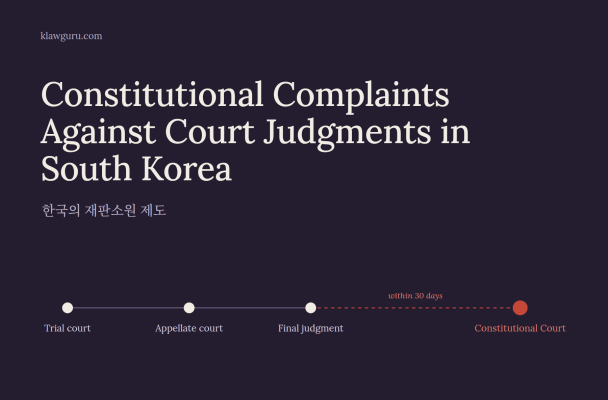
A constitutional complaint against a court judgment must be filed within 30 days from the date on which the judgment became final (Constitutional Court Act, proviso to Article 69(1)).
This is a special rule distinct from the filing period for ordinary constitutional complaints (90 days from the date on which the complainant became aware of the grounds, and one year from the date on which the grounds arose).
C. Required Contents of the Petition: Constitutional Court Act, Article 71(4)
A petition for a constitutional complaint against a court judgment must be accompanied by the written judgment and a certificate of its finality (Constitutional Court Act, Article 71(4)).
D. Transitional Provision
Under Article 2 of the Addenda to the Constitutional Court Act as amended on March 12, 2026, the former Constitutional Court Act applies to cases filed before the amendment. Accordingly, the previous principle prohibiting constitutional complaints against court judgments continues to apply to complaints filed before the amendment’s effective date (Constitutional Court Decision 2026Hun-Ma471, March 17, 2026; Constitutional Court Decision 2024Hun-Ma198, August 27, 2026).
3. Detailed Analysis of the Admissibility Requirements
A. The Judgment Must Be Final and Conclusive
Only final and conclusive judgments may be the subject of a constitutional complaint against a court judgment. A judgment that is not yet final is not subject to a constitutional complaint, because ordinary avenues of challenge such as appeal remain available. Only a final judgment of the court of last instance that has become conclusive may be challenged, and an interlocutory judgment may be corrected through a constitutional complaint against the final judgment rendered on its basis.
B. Grounds for Complaint: Falling Under a Subparagraph of Article 68(3)
1) Subparagraph 1: A Judgment Contrary to a Decision of the Constitutional Court
This covers cases in which a court infringed fundamental rights by ruling contrary to the binding force of a Constitutional Court decision (such as a decision of unconstitutionality, a decision of nonconformity with the Constitution, or a decision of limited unconstitutionality). This codifies the doctrine under which the Court had exceptionally permitted constitutional complaints against court judgments in its earlier decision of limited unconstitutionality (96Hun-Ma172 et al., December 24, 1997) and its decision of unconstitutionality (2016Hun-Ma33, April 28, 2016).
Whether a judgment applied an unconstitutional statute is determined by examining not only the operative part of the judgment but also the reasoning on which the operative part is based.
2) Subparagraph 2: Violation of Due Process
This covers cases in which fundamental rights were infringed through a violation of the principle of due process guaranteed by Article 12 and other provisions of the Constitution. Examples may include a violation of the warrant requirement or an infringement of the right to be heard.
3) Subparagraph 3: Manifest Violation of the Constitution or Statutes
This covers cases in which it is manifest that a court judgment infringed fundamental rights by violating the Constitution and statutes. Because an additional “manifestness” requirement applies, a mere error in interpreting or applying the law is not sufficient; the violation must be manifest.
In connection with this requirement, the Constitutional Court has held that the complainant must present serious and thorough arguments and substantiation as to whether the grounds set out in the subparagraphs of Article 68(3) are satisfied (Constitutional Court Decision 2026Hun-Ma1401, May 19, 2026; Constitutional Court Decision 2026Hun-Ma1753, June 30, 2026).
C. Compliance With the Filing Period
A complaint must be filed within 30 days from the date on which the judgment became final. A complaint filed after this period is dismissed as inadmissible. In practice, the Constitutional Court has dismissed numerous constitutional complaints against court judgments on the ground that they were filed more than 30 days after the judgment became final (Constitutional Court Decision 2026Hun-Ma988, April 14, 2026; Constitutional Court Decision 2026Hun-Ma1122, April 21, 2026; Constitutional Court Decision 2026Hun-Ma1051, April 14, 2026; among others).
Meanwhile, the Constitutional Court has rejected the argument that a complaint may be filed within 30 days counting from the effective date of the amended Constitutional Court Act (March 12, 2026), characterizing it as merely the complainant’s own idiosyncratic view (Constitutional Court Decision 2026Hun-Ma988, April 14, 2026).
D. Principle of Supplementarity
Under the proviso to Article 68(1) of the Constitutional Court Act, where another statute provides a remedial procedure, a complaint may be filed only after all such procedures have been exhausted. For example, a constitutional complaint against a decision dismissing a petition for retrial may be filed only after the procedures for appeal against a ruling and re-appeal have been fully exhausted (Constitutional Court Decision 2026Hun-Ma1819, June 23, 2026).
4. Cases Not Permitted as Constitutional Complaints Against Court Judgments
A. Mere Disputes Over the Outcome of a Judgment
Even where a complaint formally challenges the constitutionality of a statutory provision or seeks confirmation that the provision prohibiting complaints against court judgments is unconstitutional, it is not permitted if, in substance, it merely disputes the outcome of the court’s judgment concerning the finding or evaluation of the facts underlying the case, or the simple subsumption and application of a statutory provision in an individual, concrete case (Constitutional Court Decision 2026Hun-Ma1288, May 12, 2026; Constitutional Court Decision 2026Hun-Ma1779, June 16, 2026).
B. Insufficient Specific Arguments and Substantiation
A complaint is also dismissed as inadmissible where the complainant merely makes vague assertions that the challenged judgment is unjust, without presenting arguments and substantiation specific enough to establish whether the grounds in the subparagraphs of Article 68(3) are satisfied (Constitutional Court Decision 2026Hun-Ma1343, May 12, 2026).
C. Challenges to Decisions of the Constitutional Court
Because no appeal is permitted against a decision of the Constitutional Court, a constitutional complaint seeking revocation of a Constitutional Court decision is inadmissible (Constitutional Court Decision 2026Hun-Ma787, April 7, 2026).
5. Relationship With Constitutional Complaints Under Article 68(2) of the Constitutional Court Act (Constitutional Review Type)
A constitutional complaint of the constitutional review type under Article 68(2) of the Constitutional Court Act is a mechanism by which a party to a case pending before a court, whose motion to request constitutional review of a statute has been denied, may directly petition the Constitutional Court to review the constitutionality of the statute. Under a structure that excluded complaints against court judgments, this mechanism has served to fill the gap in remedies for judgments applying unconstitutional statutes.
The principle prohibiting complaints against court judgments still applies to constitutional complaints under Article 68(2). In other words, even if a complaint formally challenges the constitutionality of a statutory provision, it is inadmissible if, in substance, it merely disputes the outcome of the court’s judgment (Constitutional Court Decision 2024Hun-Ba13, February 6, 2024; Constitutional Court Decision 2024Hun-Ba51, February 27, 2024).
6. Constitutionality of the Former Provision Prohibiting Complaints Against Court Judgments
With respect to the phrase “except against the judgments of the courts” in the main text of former Article 68(1) of the Constitutional Court Act prior to the March 12, 2026 amendment (the provision prohibiting complaints against court judgments), the Constitutional Court has consistently held that the remainder of the provision, after the unconstitutional part was removed by the decision of limited unconstitutionality, is constitutional. The Court held that the mere fact that complaints against court judgments have been permitted by statutory amendment does not render the former prohibition unconstitutional, and that its earlier precedents remain valid (Constitutional Court Decision 2024Hun-Ma198, August 27, 2026).
7. Summary of Practical Considerations
| Item | Details |
|---|---|
| Subject | A final and conclusive court judgment |
| Grounds | Falls under one of Subparagraphs 1 to 3 of Article 68(3) |
| Filing period | Within 30 days from the date the judgment became final |
| Attachments | Written judgment + certificate of finality |
| Supplementarity | File only after exhausting all other remedial procedures |
| Arguments and substantiation | Serious and thorough arguments and substantiation for the relevant ground required |
| Applicable law | Amended Act applies to cases filed on or after March 12, 2026 |
In particular, the “manifestness” requirement under Subparagraph 3 is expected to be the most frequently contested issue in practice. Because a mere error in interpreting or applying the law, or an error in fact-finding, is not sufficient, and the violation of the Constitution or statutes must be objectively manifest, the requirement is likely to be applied narrowly. The Constitutional Court reviews complaints against court judgments strictly, taking into account the nature and role of judicial power and the functional differences between court judgments and the constitutional complaint system (Constitutional Court Decision 2026Hun-Ma1401, May 19, 2026).
8. Pending Issue: Can a Crime Victim Challenge a ‘Final’ Acquittal?
A. Background of a Current Case
Since the introduction of constitutional complaints against court judgments, such complaints have mainly been filed by criminal defendants or parties to civil litigation. A new question has now reached the Constitutional Court: whether a crime victim, who is not a party to the criminal proceedings, may seek revocation of a final judgment acquitting the defendant.
The case concerns a charge of quasi-rape aka 준강간 (Criminal Act, Article 297-2). The defendant, B, was indicted on the charge that in July 2022 he committed imitative rape against the complainant, A, despite her repeatedly expressing refusal. In June of last year, the trial court acquitted B, finding that the victim’s testimony and audio recordings alone did not establish beyond a reasonable doubt that his conduct amounted to assault or intimidation making the victim’s resistance substantially difficult; the prosecution appealed, but the appellate court upheld the acquittal in March of this year. According to reports, the evidence included a recording in which the complainant expressed refusal 75 times over the course of an hour. Despite the victim’s request, the prosecution did not appeal to the Supreme Court, citing difficulty in convening its appeal review committee. The judgment at issue is the acquittal rendered by the Suwon High Court on March 11, 2026.
The victim then filed a constitutional complaint against the acquittal. Her position is that the most important criterion for establishing a sexual offense is whether the victim consented to or intended the sexual act, and that the courts’ reliance on the degree of assault or intimidation infringed her right to sexual self-determination and her right to a fair trial. In substance, she challenges the courts’ application of the “narrowest interpretation” doctrine (choehyeopuiseol), under which assault or intimidation must reach a level that makes the victim’s resistance impossible or substantially difficult. Her side also argues that, because the prosecution’s decision not to appeal deprived her of the opportunity to have the issue resolved by the Supreme Court, a constitutional complaint was her last available avenue of relief.
On June 9, 2026, a designated three-Justice panel of the Constitutional Court referred the case to the full bench. For context, as of June 8, 2026, 736 of the 877 constitutional complaints against court judgments filed since the system’s introduction had been dismissed, and this referral brought the number of cases passing preliminary review to eight.
B. Issues Identified by the Constitutional Court
The Court stated that the full bench will examine the fundamental rights of crime victims under the Constitution, the content and scope of protection of the defendant’s rights relating to the principle of double jeopardy and the presumption of innocence, and the permissible scope of constitutional complaints filed by victims against final acquittals. The Court described the case as weighing, on one side, the acquitted defendant’s legal interest in legal stability and, on the other, the victim’s right to effective judicial protection and the constitutional demand for control over the state’s exercise of criminal justice.
C. Arguments Against Admissibility
The first obstacle is standing. The Constitutional Court Act contains no express provision on whether persons connected to a case who are not direct parties to the judgment, such as victims, may file a constitutional complaint against a court judgment. In a criminal case, the parties are the prosecution and the defendant; the victim is not a party.
The second and more fundamental obstacle is the finality of an acquittal. Article 13(1) of the Constitution provides that no person shall be punished twice for the same crime, and the Criminal Procedure Act permits retrial only for the benefit of a convicted person. If the Constitutional Court were to revoke the acquittal, the courts would have to try the defendant again, which would in effect function as a retrial to the defendant’s detriment. From this perspective, reopening a final acquittal at the request of the victim would undermine legal stability and the protection that double jeopardy guarantees to acquitted defendants.
D. Arguments for Admissibility
On the other side, Article 27(5) of the Constitution guarantees crime victims the right to make statements during trial proceedings, and the Constitutional Court has long recognized that victims may challenge a prosecutor’s decision not to prosecute through a constitutional complaint. Proponents argue that a defendant may appeal and petition for retrial, whereas a victim has no comparable remedy once the prosecution declines to appeal. On this view, a constitutional complaint against the court judgment is the only means by which a victim can contest the infringement of her own fundamental rights, and the requirement under Article 69(1) that the complaint be filed within 30 days of finality limits any threat to legal stability.
E. Comparison With Germany
Commentators have pointed to Germany for comparison. In 2021, following public outcry over the 1981 murder of a 17-year-old girl, in which the suspect had been finally acquitted in 1983 but later DNA testing linked him to the crime, the German legislature amended the Code of Criminal Procedure to permit retrial after an acquittal for murder and certain other grave crimes where new evidence emerges. The suspect was detained again under the new law, but in October 2023 the Federal Constitutional Court held the amendment unconstitutional, finding that it violated the prohibition on double jeopardy under Article 103(3) of the Basic Law and the prohibition on retroactivity, and the case ended there.
The complainant’s side distinguishes the German case. Her counsel argues that the German case involved a statute applied retroactively to a crime committed some 40 years earlier, whereas the complainant here complied with the 30-day filing period under the constitutional complaint system. They further argue that the German position, reached in a system that broadly guarantees victims’ rights throughout criminal proceedings, should not simply be transplanted to South Korea.
F. Outlook
The decision will be the first to define whether, and to what extent, persons other than the parties to a judgment, such as crime victims, may file constitutional complaints against court judgments. If the Court finds the complaint inadmissible for lack of standing or because of the double jeopardy principle, it will confirm that the new system is fundamentally a remedy for parties (only). If it reaches the merits, it may also address whether the “narrowest interpretation” doctrine in sexual offense cases is consistent with the constitutional protection of sexual self-determination. As of this writing, the case is pending before the full bench.
Thank you for reading.

