The E-7-4 Skilled Worker Visa in South Korea (2026)
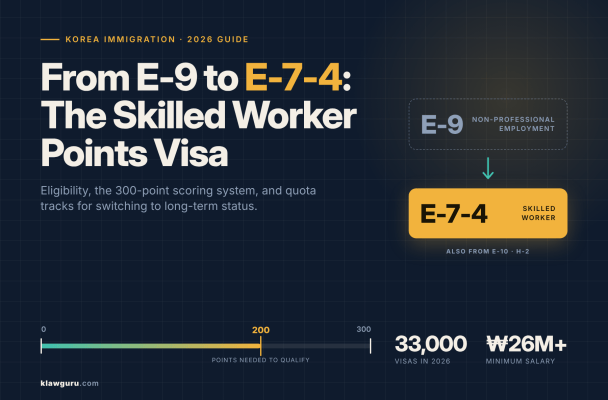
Korea’s E-7-4 visa is a point-based skilled worker visa. It lets foreign workers already in Korea on certain short-term work visas move to a status built for long-term employment and settlement. The government is expanding the program to ease labor shortages, and about 33,000 E-7-4 visas have been planned for 2026.
Key Takeaways
- Who can switch: holders of E-9 (non-professional employment), E-10 (seafarer) or H-2 (working visit) visas
- Main thresholds: 4+ years in one of those statuses, 1+ year with your current employer, an employer recommendation, a salary of at least KRW 26 million, and 200+ points
- Industries covered: manufacturing, construction, agriculture and livestock, fisheries, and more
- Stay: renewable in increments of up to 2 years
Why This Matters
An E-9 visa is not a long-term status. Most holders can stay in Korea for 4 years and 10 months at most. After that they generally have to leave or change to another visa.
For workers, the E-7-4 is the main route to staying on legally. For employers, it is a way to keep trained staff. If no one plans ahead, a worker’s forced departure can leave a business scrambling to hire and train a replacement. Both sides should start preparing well before the E-9 period runs out.
Eligibility Requirements
You must meet all four of the following:
| # | Requirement | Details |
|---|---|---|
| ① | Length of stay | At least 4 years in E-9, E-10 or H-2 status within the last 10 years, and currently working normally at your workplace |
| ② | Employment contract | A contract with your current employer for at least 2 more years, at an annual salary of KRW 26 million or more (KRW 25 million in agriculture/livestock, fisheries and coastal shipping) |
| ③ | Employer recommendation | A recommendation from the company where you have worked for at least 1 year |
| ④ | Points | 200+ points (bonus points included) out of a base maximum of 300, with at least 50 points each in income and Korean language |
Special exceptions:
- Regional route: if you have lived outside the Seoul capital region for 3+ years and have a recommendation from a metropolitan or provincial government, you meet requirement ①.
- Korean language grace period: if you meet every other points requirement (150+ points total) but fall short on Korean, you may still qualify. You must bring your Korean up to standard by your first extension (2 years). This exception applies to applications until 31 December 2026.
Who Is Not Eligible
- Anyone fined KRW 1 million or more in a criminal sentence (벌금)
- Anyone with unpaid taxes (you can apply once they are paid in full)
- Anyone who has violated the Immigration Act 4 or more times
- Anyone with a history of illegal stay of 3 months or more
- Anyone reasonably considered a threat to Korea’s national interests, public safety, economic or social order, or public morals
The Points System
Basic Items (max. 300 points)
Ⓐ Average annual income over the last 2 years (max. 120)
| Income | KRW 25–30M | KRW 30–35M | KRW 35–40M | KRW 40–45M | KRW 45–50M | KRW 50M+ |
|---|---|---|---|---|---|---|
| Points | 50 | 65 | 80 | 95 | 110 | 120 |
For agriculture/livestock, fisheries and coastal shipping, income points start at KRW 24 million.
Ⓑ Korean language proficiency (max. 120)
| Level | TOPIK 2 / KIIP Stage 2 / 41–60 pts | TOPIK 3 / KIIP Stage 3 / 61–80 pts | TOPIK 4 / KIIP Stage 4 / 81+ pts |
|---|---|---|---|
| Points | 50 | 80 | 120 |
Accepted proof: a TOPIK level, completion of a Korea Immigration and Integration Program (KIIP) stage, or a KIIP pre-assessment score.
Ⓒ Age (max. 60)
| Age | 19–26 | 27–33 | 34–40 | 41+ |
|---|---|---|---|---|
| Points | 40 | 60 | 30 | 10 |
Bonus Points
| Bonus item | Points |
|---|---|
| Recommendation from a central government ministry | 30 |
| Recommendation from a metropolitan/provincial government | 30 |
| Recommendation from your employer | 50 |
| 3+ years at your current workplace | 20 |
| 3+ years working in a depopulating area or an eup/myeon (rural town/township) area | 20 |
| Qualification certificate or a Korean degree | 20 |
| Korean driver’s license | 10 |
Bonus points can be combined. The one exception: if you have both a ministry and a local government recommendation, only one counts.
Deductions
| Deduction | 1st time | 2nd time | 3rd time or more |
|---|---|---|---|
| Criminal fine under KRW 1 million (max. −20) | −5 | −10 | −20 |
| Stay permission restricted due to unpaid taxes (max. −15) | −5 | −10 | −15 |
| Administrative sanction (including administrative fines) for up to 3 Immigration Act violations (max. −15) | −5 | −10 | −15 |
The eligibility requirements and point values may change as the program operates.
Quota Tracks: Which Route Fits You?
E-7-4 visas are allocated through several quotas, depending on who recommends you.
| Track | Who it’s for | Notes |
|---|---|---|
| Company-recommended individual track | Workers recommended by an employer they have worked for 1+ year | No ministry or local government recommendation needed if you meet the points threshold |
| Central ministry quota | Workers recommended by a relevant ministry | Recommending ministries: Employment and Labor; Trade, Industry and Energy; Agriculture, Food and Rural Affairs; Oceans and Fisheries; Land, Infrastructure and Transport; SMEs and Startups |
| Metropolitan/provincial government quota | Workers employed 1+ year at a company in that region | You must live in that region for at least 2 years after switching to E-7-4 |
| Flexible allocation quota | Extra slots for specific industries or regions | Allocated based on labor demand |
Practical Tips
For workers: start building points early. Korean language scores (TOPIK or KIIP) are the biggest variable you can control. Work experience and relevant certificates also count.
For employers: check when each worker’s E-9 period ends, and plan recommendations and salary terms in advance. Keeping a trained worker on E-7-4 is usually far easier than recruiting and training a replacement.
Thank you for reading.


Leave a Reply