The 2026 Guide to South Korea’s E-7 Work Visa: Changes, Eligibility, Salary, Company Requirements and Changing Jobs
Earlier this year, the Ministry of Justice issued a public notice on the operation of the E-7 visa for 2026. The notice includes provisions on E-7 wage requirements and issuance quotas, making it an important reference for anyone preparing for an E-7 visa.
A. Professional Employment Visas (Status of Stay)
| Visa | Eligible persons / scope of activities | 2025 quota (actual issuance) | 2026 quota |
|---|---|---|---|
| Professor (E-1) | Persons engaged in teaching or research/guidance at higher education institutions, etc. | No separate cap | No separate cap |
| Foreign Language Instructor (E-2) | Persons engaged in teaching foreign language conversation at foreign language institutes, etc. | No separate cap | No separate cap |
| Research (E-3) | Persons engaged in research in the natural sciences, social sciences, humanities, or arts and physical education, or in the research and development of advanced industrial technology | No separate cap | No separate cap |
| Technology Transfer (E-4) | Persons engaged in providing specialized knowledge or technology in the natural sciences | No separate cap | No separate cap |
| Professional Employment (E-5) | Persons engaged in professional work permitted by law, such as attorneys, certified public accountants, and physicians | No separate cap | No separate cap |
| Arts and Entertainment (E-6) | Persons engaged in artistic, entertainment, or sports activities for profit | No separate cap | No separate cap |
| Specially Designated Activities (E-7) | Persons engaged in fields designated by the Minister of Justice. Subdivided into Professionals (E-7-1), Semi-Professionals (E-7-2), General Skilled Workers (E-7-3), and Skilled Workers under the Points System (E-7-4) | <Introduced in 2024> • Care workers: 400 (15) • Aircraft (parts) manufacturing workers: 300 (98) • Power transmission line workers: 300 (78) | <Newly introduced in 2026 (planned)> • Mold makers <Introduced in 2025> • Auto repair sheet-metal and painting workers: 330 • Auto parts manufacturing workers: 100 • Slaughterhouse workers (skilled): 150 <Introduced in 2024> • Care workers: 400 • Aircraft (parts) manufacturing workers: 300 • Power transmission line workers: 300 |
| Skilled Workers – Points System (E-7-4) | 35,000 | 33,000 |
Figures in parentheses in the 2025 column indicate the number of visas actually issued.
📢 2026 E-7 Work Visa Issuance Plan
(1) E-1 to E-6 Professional Visas: Still No Separate Cap in 2026
The Professor (E-1), Foreign Language Instructor (E-2), Research (E-3), Technology Transfer (E-4), Professional Employment (E-5), and Arts and Entertainment (E-6) visas are statuses of stay for professionals working at higher education institutions and research institutes, in the professions, and in the arts.
As in 2025, these visa types will continue to be issued without a separate cap in 2026. This reflects the government’s policy of steadily expanding the recruitment of highly skilled professionals and aims to stabilize the supply of personnel for universities, research institutes, and the professions.
(2) E-7 Specially Designated Activities Visa: Managed by Occupation, with Adjustments in Some Fields
The E-7 Specially Designated Activities visa is a status of stay granted to foreign nationals working in fields designated by the Minister of Justice. It is divided into Professionals (E-7-1), Semi-Professionals (E-7-2), General Skilled Workers (E-7-3), and Skilled Workers under the Points System (E-7-4).
① E-7-4 Skilled Worker Points System
The quota was 35,000 in 2025 and has been adjusted slightly to 33,000 for 2026.
The Skilled Worker Points System gives foreign workers who meet certain requirements and score thresholds a basis for long-term stay. It is designed to secure a stable workforce for industries facing labor shortages, such as manufacturing.
② New Occupation Planned for 2026
Mold makers are scheduled to be added as a new occupation in 2026.
This occupation will be phased in to reflect labor demand in industry, and the detailed criteria will be finalized in a forthcoming detailed notice.
③ Existing Occupations Maintained
Introduced in 2025
- Auto repair sheet-metal and painting workers: 330
- Auto parts manufacturing workers: 100
- Slaughterhouse workers (skilled): 150
Introduced in 2024
- Care workers: 400
- Aircraft (parts) manufacturing workers: 300
- Power transmission line workers: 300
These occupations were introduced previously and will continue to operate in light of industry demand. Overall, the direction of E-7 visa operations in 2026 can be summarized as follows: highly skilled professional visas remain uncapped, while specific skilled-trade fields are broken down into more detailed occupations and their quotas adjusted to match industry demand.
📢 2026 E-7 Work Visa Wage Requirements
☐ Wage Requirements for the Specially Designated Activities (E-7) Status of Stay
| Category | Wage requirement |
|---|---|
| Professionals (E-7-1) | KRW 31.12 million or more per year |
| Semi-Professionals (E-7-2) | KRW 25.89 million or more per year |
| General Skilled Workers (E-7-3) | KRW 25.89 million or more per year |
| Skilled Workers (E-7-4) | KRW 26.00 million or more per year |
Earlier this year, the Ministry of Justice issued an official notice, pursuant to Article 7(7) of the Enforcement Decree of the Immigration Act, setting out the wage requirements applicable to the Specially Designated Activities (E-7) status of stay for 2026. These requirements apply from February 1, 2026 to December 31, 2026 and are applied directly in the review of E-7 Certificates of Visa Issuance and stay permits.
<E-7 : Eligibility, Salary, Company Requirements and Changing Jobs>
Korean companies are hiring more foreign professionals than ever. Many international students now stay in Korea after graduating instead of going home, and businesses also recruit experienced talent from abroad to compete globally.
Finding the right candidate is only the first step. To work legally in Korea, a foreign professional needs a work visa, and for most professional roles that means the E-7 (Specific Activities) visa. This guide explains who qualifies, what the employer needs, how to apply, and what to watch for when changing jobs.
Key Takeaways
- The E-7 is for skilled, specialized work. It can’t be used for simple manual labor, and the applicant must prove their expertise.
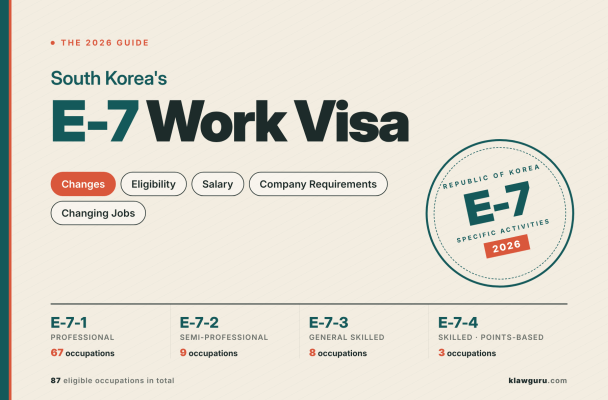
- 87 occupations are eligible across four E-7 subtypes. The most common is the E-7-1 (professional), which covers 67 occupations.
- Applicant: needs the right mix of degree and experience, a major that matches the job, and a salary of generally at least 80% of Korea’s per-capita GNI.
- Employer: generally needs 5+ Korean employees, no unpaid taxes, and foreign staff at no more than 20% of the Korean workforce.
- Changing jobs: some occupations need permission before the move. Others must report within 15 days after it, and late reports are fined up to KRW 2 million (i.e. non-criminal fine).
Why This Matters
E-7 applications are screened strictly to protect jobs for Korean nationals. Both the applicant and the hiring company are examined. A refusal stays on record and makes reapplying much harder, so it pays to get the first application right.
1. What Is the E-7 Visa?
The E-7 lets a foreign national work in a specific professional position in Korea. Applicants must prove their expertise through documents, under rules set by the Ministry of Justice.
There are four subtypes:
| Visa | Category | Who it covers |
|---|---|---|
| E-7-1 | Professional | Managers and professionals (67 occupations) |
| E-7-2 | Semi-professional | Clerical and service workers (9 occupations) |
| E-7-3 | General skilled | Skilled and related trades workers (8 occupations) |
| E-7-4 | Skilled (points-based) | Workers moving up from E-9 and similar visas through a points system (3 occupations) |
Most companies need the E-7-1. It covers roles such as marketers, overseas sales staff and engineers. Requirements vary slightly by occupation code, so identify the correct code for the position before you apply.
2. Full List of Eligible Occupations (87)
Numbers in brackets are Korean occupation codes. “Formerly” shows a previous code. Codes beginning with “S” are special codes.
E-7-1 Professionals: 67 occupations
A. Managers (15)
| # | Occupation | Code |
|---|---|---|
| 1 | Senior executives of economic interest organizations | S110 |
| 2 | Corporate senior executives | 1120 |
| 3 | Management support managers | 1212 (formerly 1202) |
| 4 | Education managers | 1312 |
| 5 | Insurance and finance managers | 1320 |
| 6 | Culture, arts, design and video managers | 1340 |
| 7 | Information and communications managers | 1350 |
| 8 | Other professional services managers | 1390 |
| 9 | Construction and mining managers | 1411 |
| 10 | Production managers | 1413 |
| 11 | Agriculture and fishery managers | 14901 |
| 12 | Sales and marketing managers | 1511 |
| 13 | Transport managers | 1512 |
| 14 | Accommodation, travel, entertainment and sports managers | 1521 |
| 15 | Food service managers | 1522 |
B. Professionals and related workers (52)
| # | Occupation | Code |
|---|---|---|
| 1 | Life science professionals | 2111 |
| 2 | Natural science professionals | 2112 |
| 3 | Social science researchers | 2122 |
| 4 | Computer hardware engineers | 2211 |
| 5 | Telecommunications engineers | 2212 |
| 6 | Computer systems designers and analysts | 2221 |
| 7 | System software developers | 2222 |
| 8 | Application software developers | 2223 |
| 9 | Web developers | 2224 (formerly 2228) |
| 10 | Data professionals | 2231 (formerly 2224) |
| 11 | Network system developers | 2232 (formerly 2225) |
| 12 | Information security professionals | 2233 (formerly 2226) |
| 13 | Architects | 2311 |
| 14 | Architectural engineers | 2312 (new) |
| 15 | Civil engineering professionals | 2313 (formerly 2312) |
| 16 | Landscape engineers | 2314 (formerly 2313) |
| 17 | Urban planning and transport professionals | 2315 (formerly 2314) |
| 18 | Chemical engineers | 2321 |
| 19 | Metal and materials engineers | 2331 |
| 20 | Electrical engineers | 2341 (formerly 2351) |
| 21 | Electronics engineers | 2342 (formerly 2352) |
| 22 | Mechanical engineers | 2351 (formerly 2353) |
| 23 | Plant engineers | 23512 (formerly 23532) |
| 24 | Robotics engineering professionals | 2352 |
| 25 | Automotive, shipbuilding, aircraft and railway engineering professionals | S2353 |
| 26 | Industrial safety and risk professionals | 2364 |
| 27 | Environmental engineers | 2371 (formerly 2341) |
| 28 | Gas and energy engineers | 2372 (formerly 9233) |
| 29 | Textile engineers | 2392 |
| 30 | Drafters | 2395 (formerly 2396) |
| 31 | Nurses | 2430 |
| 32 | University lecturers | 2512 |
| 33 | Technical instructors at overseas technical schools | 2543 |
| 34 | Education professionals | 2591 (formerly 25919) |
| 35 | Teachers at foreign schools, foreign educational institutions, international schools and schools for the gifted | 2599 |
| 36 | Legal professionals | 261 |
| 37 | Government and public administration professionals | 2620 |
| 38 | Administrative staff of special institutions | S2620 |
| 39 | Management and consulting professionals | 2715 |
| 40 | Finance and insurance professionals | 272 |
| 41 | Product planning professionals | 2731 |
| 42 | Travel product developers | 2732 |
| 43 | Advertising and PR professionals | 2733 |
| 44 | Survey and research professionals | 2734 |
| 45 | Event planners | 2735 |
| 46 | Overseas sales representatives | 2742 |
| 47 | Technical sales representatives | 2743 |
| 48 | Technology management professionals | S2743 |
| 49 | Translators and interpreters | 2814 |
| 50 | Announcers | 28331 |
| 51 | Designers | 285 |
| 52 | Video designers | S2855 |
E-7-2 Semi-professionals: 9 occupations
A. Clerical workers (5)
| # | Occupation | Code |
|---|---|---|
| 1 | Sales clerks at duty-free shops or in Jeju English Education City | 31215 |
| 2 | Air transport clerks | 31264 |
| 3 | Hotel receptionists | 3922 |
| 4 | Medical coordinators | S3922 |
| 5 | Customer service clerks | 3991 |
B. Service workers (4)
| # | Occupation | Code |
|---|---|---|
| 1 | Transport service workers | 431 |
| 2 | Tourist interpreter-guides | 43213 |
| 3 | Casino dealers | 43291 |
| 4 | Chefs and cooks | 441 |
E-7-3 General skilled workers: 8 occupations
| # | Occupation | Code |
|---|---|---|
| 1 | Animal breeders | 61395 |
| 2 | Aquaculture technicians | 6301 |
| 3 | Halal butchers | 7103 |
| 4 | Musical instrument makers and tuners | 7303 |
| 5 | Shipbuilding welders | 7430 |
| 6 | Aircraft mechanics | 7521 |
| 7 | Ship electricians (newly added) | 76212 |
| 8 | Ship painters | 78369 |
E-7-4 Points-based skilled workers: 3 occupations
| # | Occupation | Code |
|---|---|---|
| 1 | Skilled workers in root industries | S740 |
| 2 | Skilled workers in agriculture, livestock and fisheries | S610 |
| 3 | Skilled workers in general manufacturing and construction | S700 |
3. Requirements for the Foreign Applicant
Education and experience
The applicant generally needs one of the following:
- A master’s degree or higher in a relevant field
- A bachelor’s degree in a relevant field plus at least 1 year of relevant experience
- At least 5 years of relevant experience, if they don’t have a bachelor’s degree
Who gets relaxed requirements?
| Applicant | What is waived |
|---|---|
| Graduate of a Korean university (bachelor’s or higher) | Work experience and the major-to-job link |
| Graduate of a Korean junior college | Work experience |
| Bachelor’s or higher from a world-class university | Work experience |
| 1+ year at a Global Fortune 500 company | Education and work experience |
| Annual salary of 3× Korea’s per-capita GNI or more | Education and work experience |
💡 Good news for international students: a foreign student who earns a bachelor’s degree or higher in Korea can be hired with no work experience.
The major must match the job
This is where many applications fail. A strong CV isn’t enough. The applicant’s major or experience must clearly relate to the position.
- ❌ Very unlikely: an electronic engineering graduate hired as a marketer.
- ⚠️ Possible, but needs careful framing: a visual design graduate hired in marketing. Defining the role as a content marketer or UX marketer, and explaining the link in the employment justification letter, can make the difference.
You need to show why the company needs this particular foreign national.
4. Salary Requirement
A minimum salary applies so that foreign workers aren’t used as cheap labor and Korean jobs are protected.
| Rule | Minimum annual salary |
|---|---|
| General rule | 80% or more of the previous year’s per-capita GNI |
| Exception | 70% or more of GNI for qualifying SMEs, mid-sized and venture companies, or companies outside the Seoul capital area, especially when hiring someone with 3 years or less of Korean work experience. State this in the employment contract. |
🚨 Check the current figure. The GNI figure published by the Bank of Korea rises every year. In 2023 the 80% threshold was about KRW 33.76 million, and the 2026 threshold is considerably higher. Confirm the latest Ministry of Justice figure before drafting the contract, and make sure the salary also meets the minimum wage.
5. Requirements for the Hiring Company
The company is screened just as closely as the applicant. In general, it must meet all of the following:
| Requirement | Details |
|---|---|
| Korean workforce | At least 5 Korean employees |
| Social insurance | Korean employees enrolled in the four major social insurances for 3 months or more |
| Foreign worker ratio | Foreign hires generally capped at 20% of Korean employees |
| Taxes | No unpaid national or local taxes |
| Compliance | No other violations, such as unpaid wages |
How the Korean workforce is counted
- Small, domestic-focused businesses: companies with fewer than 5 Korean employees that mainly serve the domestic market are, in principle, not allowed to invite foreign workers.
- Who counts as an employee: a person listed on the employment insurance register for 3 months or more and paid at least the minimum wage.
- New companies: a 3-month employment insurance record is required, so a company can generally apply only 3 months after opening (counted from its business registration date).
- Industry rules: some industries have their own additional employer requirements, and those must also be met.
Who counts toward the 20% foreign worker cap
- Not counted: workers holding E-9, E-10, H-2, F-2 (ethnic Chinese residents), F-5 (permanent residents) or F-6 (marriage migrants).
- Counted: other work-eligible statuses, such as F-2 (residence).
Startups and small businesses
New startups that don’t yet have 5 Korean employees, a tax payment record or prior-year revenue may still qualify under special exceptions. Get professional advice before applying rather than risking a refusal.
Hiring a graduate of a foreign university is reviewed more strictly. For some occupations it requires a KOTRA employment recommendation letter.
6. How to Apply: Step by Step
| Step | What happens |
|---|---|
| 1 | Check eligibility and sign the employment contract |
| 2 | The company prepares its documents |
| 3 | The foreign employee prepares their documents |
| 4 | Apply in person at the immigration office |
| 5 | Pass screening and receive the E-7 visa |
💡 Tip: check visa eligibility after the interview but before confirming the hire. Follow the residence status manual on Hi Korea when you apply.
Required documents
| Company | Foreign employee |
|---|---|
| Employment contract | Integrated application form |
| Employment justification letter | Passport |
| Business registration certificate | Alien registration card |
| Tax payment certificates (national and local) | ID photo |
| VAT tax base certificate | Degree certificate and transcripts |
| Four major insurances enrollee list | Certificates of employment/experience |
| Residential lease contract | |
| Criminal record certificate from home country |
⚠️ The hardest part: each occupation needs its own additional supporting documents, and they vary by industry and position. Many applications are rejected at this stage. The applicant’s past immigration record (for example, any history of overstaying) is also reviewed.
7. Changing Employers on an E-7 Visa
E-7 holders can change jobs, but they must follow an immigration procedure first. Which one applies depends on the occupation.
| Procedure | When | Applies to |
|---|---|---|
| Prior permission | Before starting at the new company | 14 designated occupations |
| Post-change report | Within 15 days of the change | All other occupations |
🚨 Starting work at a new company before permission is granted can seriously jeopardize your status of stay.
Occupations that need prior permission
There are 14 designated occupations, including:
- Mechanical engineers
- Drafters
- Designers
- Sales clerks
- Chefs and cooks
- Medical coordinators
- Shipbuilding welders
- E-7-4 points-based skilled workers
These occupations are screened more strictly, and each company has a cap on how many foreign workers it may employ in them. If you’re changing jobs for personal reasons, you also need a release consent letter from your current employer.
Real example: architectural engineer (code 2312)
A structural design firm hired a Malaysian national as an architectural engineer (2312). He had graduated in architectural engineering from Seoul National University, had overseas work experience, and spoke Korean, English and Malay, a good fit for international projects.
Code 2312 is a post-change report occupation, so the change only had to be reported within 15 days. His occupation and experience clearly matched, and the process went smoothly.
Late reports are fined up to KRW 2 million (i.e. non-criminal fine)
- If you miss the 15-day deadline, a fine is imposed based on how late you are, from KRW 100,000 up to KRW 2,000,000 (i.e. non-criminal fine).
- An agent can file the report on your behalf.
- The former employer must also file an employment change report when the worker leaves. Many companies forget this.
- Leaving before your resignation is properly processed (for example, during a dispute) can cause problems for both sides.
The new employer is screened again
Moving to a new company means a fresh eligibility review of that company.
- If the new job doesn’t match your original purpose of stay, the change is generally refused.
- Expect to submit documents similar to a first-time application: an employment justification letter and proof of education and experience.
- Make the link between occupation, major and experience crystal clear.
- Give yourself plenty of time, because the paperwork is substantial.
✅ Three checks before you change jobs
- Prior permission or post-change report? Find out which applies to your occupation.
- Release consent letter: do you need one, or does an exemption apply?
- Deadline and new employer: note the 15-day deadline and confirm the new company meets the requirements.
Simple rule: get permission before you start, report on time, and prepare your documents early.
Final Thoughts
An E-7 visa isn’t issued just because the paperwork is submitted. Success depends on showing a clear link between the job and the applicant’s background, and on explaining why the company needs this hire. Because a refusal makes future applications harder, employers should check both the candidate’s and the company’s eligibility before making an offer, and should always confirm the latest requirements in the Ministry of Justice’s E-7 manual on HiKorea.
Thank you for reading.


Leave a Reply