Renting in South Korea as a Foreigner: How to Protect Your Rights as a Tenant (2026)
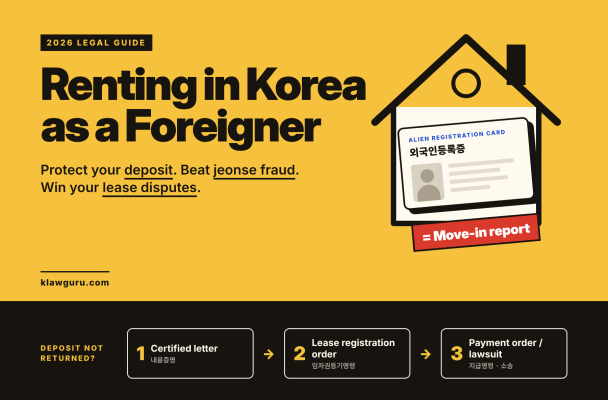
This guide covers the housing and lease problems foreign tenants in South Korea most often run into, based on the law and court rulings. Legal terms are explained as simply as possible.
1. Are foreign nationals protected as tenants in Korea?
A. The core principle
Under Korea’s Housing Lease Protection Act, a tenant who has ① taken possession of the home (moved in) and ② completed resident registration (a move-in report, 전입신고) gains opposability (대항력): the right to assert the lease against third parties, such as a new owner. (Housing Lease Protection Act, Article 3(1)) Foreign nationals can’t register as residents in the Korean sense, but the law provides an alternative.
B. Alien registration or domestic residence report = a move-in report
Article 88-2(2) of the Immigration Act expressly states: “Alien registration and reports of change of place of stay under this Act shall substitute for resident registration and move-in reports.”
The Supreme Court has read this provision broadly. It held that alien registration, a report of change of place of stay, a domestic residence report (국내거소신고) or a report of change of residence, made by a foreign national or a foreign-national Korean (외국국적동포) under the Immigration Act or the Overseas Koreans Act, has the same legal effect as resident registration for opposability under Article 3(1) of the Housing Lease Protection Act. The Court also made clear that the result is no different just because these registrations give weaker public notice than resident registration. (Supreme Court Decision 2014Da218030, 218047, 13 October 2016, Claim for Delivery of Building, etc. / Lease Deposit; Supreme Court Decision 2015Da254224, 28 September 2018, Lease Deposit; Supreme Court Decision 2015Da254507, 11 April 2019, Objection to Distribution)
C. Your family’s alien registration also counts
Resident registration covers not only the tenant but also family members such as a spouse and children. So the requirement for opposability is met even if it’s a foreign family member living with the tenant, rather than the tenant, who completes alien registration or a domestic residence report. (Supreme Court Decision 2015Da14136, 13 October 2016, Objection to Distribution; Supreme Court Decision 2014Da218030, 218047, 13 October 2016)
A report of change of place of stay filed by a foreign tenant’s family member also meets the requirement. (Chuncheon District Court Decision 2017Na51867, 27 June 2018, Objection to Distribution)
Real case: a tenant was a Korean national living abroad (재외국민). Their foreign spouse (a Chinese national) filed an alien registration address change to the rental address on 12 November 2014. The court held that the tenant gained opposability from 13 November 2014, the following day. (Busan District Court, Eastern Branch, Decision 2019GaDan3525, 16 January 2020, Objection to Distribution)
D. Korean nationals living abroad (재외국민) are also protected
Where a Korean national living abroad signs a lease and a foreign or foreign-national Korean family member living with them completes alien registration or a domestic residence report, the tenant has opposability. (Supreme Court Decision 2015Da14136, 13 October 2016; Supreme Court Decision 2014Da218030, 218047, 13 October 2016) A domestic residence report or change-of-residence report filed by the Korean national abroad themselves also has the same effect as resident registration. (Supreme Court Decision 2015Da254507, 11 April 2019, Objection to Distribution)
E. Quick reference
| Status | How to gain opposability |
|---|---|
| Foreign national (long-term stay) | Alien registration + report of change of place of stay |
| Foreign-national Korean (외국국적동포) | Domestic residence report + report of change of residence |
| Korean national abroad (since 2015) | Can file a resident registration move-in report |
| Korean national abroad (before 2015) | Opposability through a cohabiting foreign family member’s alien registration |
| Tenant’s foreign family member | The family member’s alien registration, change of place of stay or residence report satisfies the tenant’s requirement |
2. Fixed-date stamp (확정일자) and priority repayment right
If you have opposability (possession + alien registration, etc.) and a fixed-date stamp (확정일자) on your lease contract, you gain a priority repayment right (우선변제권). This is the right to recover your deposit ahead of other creditors if the property is sold at auction or public sale. (Housing Lease Protection Act, Article 3-2(2))
- Where to get the fixed-date stamp: the local registry office, your community service center (주민센터) or a notary office.
- When it takes effect: from 00:00 on the day after you have all three: possession, alien registration (equivalent to a move-in report) and the fixed-date stamp. (Housing Lease Protection Act, Article 3(1))
Caution: even if you file your alien registration address change and get the fixed-date stamp on the day you move in, if the landlord grants a mortgage (근저당권) to a third party on the same day, the mortgagee ranks ahead of you. If possible, get the fixed-date stamp before you move in.
3. You must keep living there to keep opposability
Opposability isn’t something you meet once. You have to keep it. Possession of the home and resident registration (including alien registration, etc.) must be in place not only when opposability is acquired but continuously, to maintain it. (Supreme Court Decision 2025Da213466, 8 January 2026, Deposit; Supreme Court Decision 2024Da326398, 15 April 2025, Return of Lease Deposit)
If the tenant loses possession of the home, opposability ends at that moment. Filing a new move-in report or registering the lease later doesn’t restore it retroactively. New opposability arises only from the time of registration. (Supreme Court Decision 2024Da326398, 15 April 2025)
Real case: a tenant applied for a lease registration order before moving out, but the lease wasn’t actually registered until after they moved. The court held:
- the tenant’s opposability ended when they lost possession by moving out;
- the later registration didn’t restore it retroactively, and only created new opposability from the date of registration.
As a result, a mortgage created before the move ranked ahead, and the tenant couldn’t assert the lease against the buyer at auction. (Supreme Court Decision 2024Da326398, 15 April 2025)
However, if the tenant completes lease registration while still keeping possession and registration (alien registration, etc.), they don’t lose the opposability or priority repayment right they already had, even if they later lose those requirements. (Housing Lease Protection Act, proviso to Article 3-3(5); Suwon District Court, Seongnam Branch, Decision 2025GaHap1645, 18 August 2026, Confirmation of Non-Existence of Debt)
4. If you can’t get your deposit back: step by step
Step 1: Send a certified letter (내용증명)
If the lease has ended and the landlord won’t return your deposit, first demand it by certified content mail (내용증명). This is an officially recorded demand letter and can be used as evidence in later litigation.
Step 2: Apply for a lease registration order (임차권등기명령)
If the landlord doesn’t return the deposit, you can apply for a lease registration order. It lets you keep your opposability and priority repayment right even if you have to move out. (Housing Lease Protection Act, Article 3-3(1))
Key points of a lease registration order:
| Item | Details |
|---|---|
| When you can apply | The lease has ended and the deposit hasn’t been returned |
| Where to apply | The district court, branch court or municipal court with jurisdiction over the property |
| Possible after you’ve moved out? | Yes |
| Effect | You keep opposability and priority repayment even after moving out (but registration must be completed before you move) |
A tenant who has already lost possession after the lease ended can still apply for a lease registration order, as long as the deposit hasn’t been returned. (Supreme Court Decision 2003Da62255 (main claim), 2003Da62262 (counterclaim), 28 October 2004, Eviction / Cancellation of Lease Registration; Supreme Court Decision 2024Ma8598, 15 April 2025, Housing Lease Registration)
Even if you received your deposit from the Korea Housing & Urban Guarantee Corporation (HUG), that isn’t repayment from the landlord. It still counts as “the deposit has not been returned”, so you can still apply for a lease registration order. (Supreme Court Decision 2024Ma8598, 15 April 2025)
Effect of lease registration: complete it before you move.
- Registered before moving: if you already had opposability or a priority repayment right before the order, you keep them even if you move out after the lease is registered. (Housing Lease Protection Act, proviso to Article 3-3(5))
- Registered after moving: your lost opposability isn’t restored retroactively, and only new opposability arises from the registration date.
You must complete the lease registration before moving out to keep your existing opposability. (Supreme Court Decision 2024Da326398, 15 April 2025)
Step 3: Payment order or lawsuit
If the landlord still doesn’t return the deposit after lease registration, you can apply to the court for a payment order (지급명령) or file a lawsuit for return of the deposit. (Civil Procedure Act, Article 462)
Caution: lease registration under Article 621 of the Civil Act and late-payment damages. If the lease was registered with the landlord’s consent under Article 621 of the Civil Act, the landlord’s duty to return the deposit and the tenant’s duty to cancel the registration must be performed simultaneously. The tenant can claim late-payment damages only after performing, or tendering performance of, the duty to cancel the registration, which puts the landlord in default. (Supreme Court Decision 2024Da261989, 12 December 2024, Unjust Enrichment) This is different from registration through a lease registration order under Article 3-3 of the Housing Lease Protection Act.
5. Foreign victims of jeonse fraud and the Special Act
A. Requirements under the Special Act
To be recognized as a jeonse fraud victim under the Special Act on Support for Victims of Jeonse Fraud and Housing Stability, you must meet all of the following. (Special Act, Article 3(1))
| Requirement | Details |
|---|---|
| ① Opposability and priority repayment | Possession + resident registration (move-in report) + fixed-date stamp (or lease registration / registered jeonse right) |
| ② Deposit limit | KRW 500 million or less (the committee may raise this by up to KRW 200 million) |
| ③ Loss incurred | Landlord’s bankruptcy or rehabilitation, start of auction or public sale, an enforceable title obtained, etc., and two or more victims |
| ④ Landlord’s intent | Reasonable grounds to suspect the landlord intended not to return the deposit |
The Special Act applies only to tenants who are natural persons. (Special Act, main text of Article 3(1))
B. Does it apply to foreign nationals?
Article 3(1)1 of the Special Act refers to having “completed possession of the home and resident registration under Article 3 of the Housing Lease Protection Act.” As explained above, a foreign national’s alien registration or domestic residence report has the same legal effect as resident registration, so foreign tenants can meet this requirement.
The Special Act doesn’t expressly say that alien registration is treated the same as resident registration, however, so this could become an issue when victim status is decided. The better view is that the opposability rules under the Housing Lease Protection Act should apply equally when interpreting the Special Act, but no established case law on this point has been confirmed.
C. When the Special Act doesn’t apply
You can’t get protection under the Special Act if: (Special Act, Article 3(2))
- you have deposit guarantee insurance (HUG, etc.) that will return your full deposit;
- you can recover your full deposit through top-priority repayment for small-deposit tenants (소액임차인 최우선변제); or
- you can recover your full deposit on your own by exercising your opposability and priority repayment rights.
6. Ending the lease early
A. Ending a tacitly renewed lease
If neither the landlord nor the tenant gives notice of non-renewal at least 2 months before the lease ends, the lease is tacitly renewed (묵시적 갱신). (Housing Lease Protection Act, Article 6(1)) *More precisely, at least 6 months – 2 months for the landlord; at least 2 months for the tenant. The tenant may then give the landlord notice of termination at any time, and termination takes effect 3 months after the landlord receives the notice. (Housing Lease Protection Act, Article 6-2(1) and (2))
The Supreme Court has held that, for a lease renewed when the tenant exercised their right to request renewal (계약갱신요구권), the tenant’s termination takes effect 3 months after notice, even if the notice arrived before the renewed term began. (Supreme Court Decision 2023Da258672, 11 January 2024, Return of Lease Deposit, etc.) Lower courts have applied the same rule to tenants terminating after a tacit renewal. (Seoul Central District Court Decision 2026GaDan33114, 7 May 2026, Lease Deposit; Suwon District Court Decision 2024GaDan558160, 24 September 2024, Lease Deposit; Changwon District Court Decision 2024GaDan107804, 9 August 2024, Lease Deposit)
7. How far you must restore the property (원상회복)
A. The basic principle
When the lease ends, the tenant must return the property restored to its original condition. (Civil Act, Articles 654 and 615) This means the condition at the start of the lease. More specifically, after using the property in the ordinary way according to its intended use, the tenant must return it in a condition that doesn’t interfere with normal use. (Suwon District Court Decision 2025Na56553, 9 April 2026, Lease Deposit; Seoul Central District Court Decision 2023GaDan5433117, 29 May 2025, Lease Deposit)
B. Ordinary wear and tear isn’t the tenant’s responsibility
Ordinary wear and tear (통상의 손모) is the loss in value that naturally comes from the tenant using the property during the lease. It is an inherent, expected part of any lease, and its economic value is already reflected in the rent. Making the tenant restore ordinary wear and tear is therefore unfair. (Busan District Court Decision 2025Na44017, 28 May 2026, Return of Lease Deposit; Suwon District Court Decision 2025Na56553, 9 April 2026; Seoul Eastern District Court Decision 2022GaDan117324, 31 March 2023, Lease Deposit)
C. How the scope of restoration is decided
The content and scope of the duty to restore are decided case by case, taking into account: (Supreme Court Decision 2017Da268142, 30 August 2019, Damages (Other); Daegu District Court Decision 2023Na329701, 17 October 2024, Damages (Other))
- how and on what terms the lease was entered into;
- the condition of the property at the start of the lease; and
- any repairs or alterations made by the tenant.
D. Fixtures installed by a previous tenant
As a rule, you only need to return the property as it was when you rented it. You don’t have to remove fixtures installed by someone before you. (Suwon District Court Decision 2015Na27351, 16 June 2016, Return of Deposit) There may be an exception if you can be said to have taken over the previous tenant’s restoration duty. One example is where you took over and used the previous tenant’s fixtures and your lease contains a special restoration clause. (Supreme Court Decision 2017Da268142, 30 August 2019)
E. The landlord bears the burden of proof
To deduct restoration costs from the deposit, the landlord must prove that the damage was caused by the tenant and goes beyond ordinary wear and tear. If the landlord can’t prove this, the deduction is not allowed. (Busan District Court Decision 2025Na44017, 28 May 2026)
8. Maintenance fee (관리비) disputes
A. Who pays after the lease ends
If the lease has ended and the deposit hasn’t been returned, and the tenant only continues to occupy the property without actually using it, the landlord must pay the maintenance fees until the property is handed back. (Supreme Court Decision 2020Da286102 (main claim), 2020Da286119 (counterclaim), 1 April 2021, Eviction (Delivery) / Return of Deposit; Busan District Court Decision 2025Na44017, 28 May 2026; Seoul Central District Court Decision 2023GaDan5433117, 29 May 2025)
B. If the tenant actually uses the property
If the tenant actually uses the property after the lease ends, the tenant pays the maintenance fees for that period. In one case, a tenant held events in the building on two separate days after the lease ended, and the court held that the tenant had to pay the maintenance fees for those days. (Supreme Court Decision 2020Da286102, 2020Da286119, 1 April 2021)
Unpaid maintenance fees up to the last day the tenant actually used the property after the lease ended may be deducted from the deposit. Fees for the period after that, when the tenant only remained in occupation, are the landlord’s responsibility. (Suwon District Court Decision 2025Na56553, 9 April 2026)
C. Summary
| Situation | Who pays maintenance fees |
|---|---|
| Lease ended, deposit not returned, tenant only occupying | Landlord |
| Lease ended, tenant actually using the property | Tenant |
| During the lease | As per the contract (usually the tenant) |
9. Key takeaways
- Alien registration or a domestic residence report = a move-in report. It gives you opposability.
- Family members count. A family member’s alien registration or report of change of place of stay can also satisfy the tenant’s requirement.
- If your deposit isn’t returned: certified letter → lease registration order → payment order or lawsuit, in that order.
- You can still apply for a lease registration order after you’ve moved out, and after receiving your deposit from HUG.
- Complete lease registration before moving out to keep your existing opposability. Registering after you move only creates new opposability.
- The Jeonse Fraud Special Act applies to tenants who are natural persons. It should in principle apply to foreign nationals too, but with no express provision, check this in practice.
- Restoration excludes ordinary wear and tear. Returning the property as it was when you rented it is enough, and the landlord must prove any damage beyond ordinary wear and tear.
- If the lease has ended and the deposit hasn’t been returned, and you’re only occupying the property, the landlord pays the maintenance fees.
Thank you for reading.


Leave a Reply