Labor and Pay: A Legal Guide for Foreign Residents in South Korea (2026)
1. Filing a wage claim with the labor office
A. Basic principles
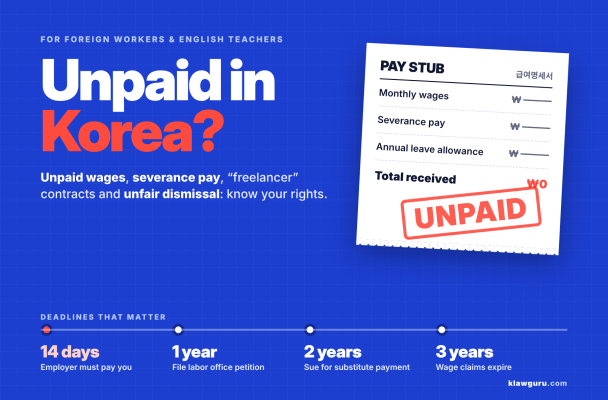
When an employee leaves, the employer must pay all money owed, including wages and severance pay, within 14 days of the leaving date. (Labor Standards Act, Article 36) An employer who doesn’t is subject to criminal penalties of up to 3 years’ imprisonment or a fine of up to KRW 20 million. Late-payment interest also accrues on amounts paid after the 14 days. (Labor Standards Act, Article 37)
The statute of limitations for wage claims is 3 years. (Labor Standards Act, Article 49) Severance pay claims also have a 3-year limitation period. (Employee Retirement Benefit Security Act, Article 10) The period runs from each wage payment date for wages, and from the day after leaving for severance pay.
Important practical point: filing a petition or criminal complaint with the labor office does not, by itself, interrupt the limitation period. To interrupt it, you need one of the grounds in Article 168 of the Civil Act, such as filing a civil lawsuit, attachment or provisional attachment, a provisional injunction, or the debtor acknowledging the debt.
There is one exception. Suppose that during the labor office’s investigation the employer makes a statement admitting the wage claim, and the worker then withdraws the petition so that the employer escapes criminal punishment. That statement may count as an acknowledgment of the debt, which interrupts the limitation period, or as a waiver of the benefit of the limitation period. (Daegu District Court Decision 2019Na301850, 15 January 2020)
B. Overview of the petition process
A worker who hasn’t received wages or severance pay files a petition (진정서) with the Regional Employment and Labor Office with jurisdiction over the employer’s location.
- A labor inspector investigates both the employer and the worker.
- If the unpaid wages are confirmed, the inspector orders the employer to pay.
- If the employer doesn’t comply, the case is referred to the prosecutor.
If unpaid wages are confirmed during the petition process, a Certificate of Unpaid Wages, etc. and Employer (체불 임금등·사업주 확인서) is issued. You can use it to apply for the simplified substitute payment (간이대지급금) or to file a civil lawsuit. The certificate is issued within 3 days of the application, or of the date the labor inspection is completed. (Enforcement Rule of the Wage Claim Guarantee Act, Article 9-2(2))
There are two kinds of certificate:
- For claiming the substitute payment: issued only if the employer admits the unpaid wages and the worker and employer agree on the amount. If the employer denies it, this certificate isn’t issued, and a substitute payment claim based on a certificate issued in breach of this rule will be rejected. (Seoul Administrative Court Decision 2023GuHap58619, 8 December 2023)
- For filing a lawsuit: available even if the employer disputes the claim.
C. Sample complaint letter in English
As a rule, petitions to the labor office should be in Korean. Foreign workers can have English content like the sample below translated before submitting it, or ask for interpretation support.
[Sample: Complaint of Unpaid Wages]
To: [Name of Regional Employment and Labor Office]
(e.g., Seoul Regional Employment and Labor Office)
From: [Your Full Name], Nationality: [Country], Date of Birth: [DOB],
Alien Registration Number: [ARC No.], Address: [Your Address in Korea],
Contact: [Phone / Email]
Subject: Complaint Regarding Unpaid Wages and Severance Pay
I, [Your Name], worked as an English instructor at [Academy/Company Name], located at [Address], from [Start Date] to [End Date].
Despite my resignation/termination on [End Date], my employer, [Employer’s Name], has failed to pay the following amounts within 14 days as required by Article 36 of the Labor Standards Act:
| Item | Amount (KRW) |
|---|---|
| Unpaid wages (Month/Period) | ₩ |
| Unpaid severance pay | ₩ |
| Unpaid annual leave allowance | ₩ |
| Total | ₩ |
I respectfully request that the Labor Inspector investigate this matter and order my employer to pay the outstanding amounts.
Attached: Copy of employment contract, pay stubs, bank records, text messages, etc.
Date: [Date]
Signature: [Your Name]
Practical tip: you can ask for an interpreter when you visit the labor office, and you can also file a petition online through the Ministry of Employment and Labor website (www.moel.go.kr).
2. Simplified substitute payment (간이대지급금): the exact deadlines
A. The 3-year limitation period and the substitute payment deadlines are separate
The 3-year limitation period for wage claims and the deadlines for the simplified substitute payment are separate rules. You can pursue the wage claim itself within 3 years of leaving. To receive the simplified substitute payment, however, you must also meet the separate deadlines explained below.
B. The two routes compared
There are two routes to the simplified substitute payment. Each has its own deadline for filing the petition or lawsuit and its own deadline for applying for the payment. (Wage Claim Guarantee Act, Article 7(1)4 and 5; Enforcement Decree, Article 7(2) and Article 9(1))
| Route 4 (court judgment, etc.) | Route 5 (certificate) | |
|---|---|---|
| Based on | Final judgment, payment order, conciliation, etc. | Certificate of Unpaid Wages, etc. and Employer |
| Deadline to file | Lawsuit, etc. within 2 years from the day after leaving | Petition, etc. within 1 year from the day after leaving |
| Deadline to apply for payment | Within 1 year of the judgment, etc. | Within 6 months of the certificate first being issued |
| Employer must admit? | No, available even if the employer denies it | Yes, the employer must admit the unpaid wages |
| Difficulty | Requires a civil lawsuit | Apply directly, no lawsuit needed |
C. Detailed requirements for each route
1) Route 5: substitute payment based on the certificate (the easiest)
① Petition deadline: you must file a petition, etc. with the labor office within 1 year from the day after leaving. (Enforcement Decree, Article 7(2)2)
② Certificate condition: the employer must admit the unpaid wages, and the worker and employer must agree on the amount. If the employer denies it, the certificate for claiming the substitute payment isn’t issued. (Seoul Administrative Court Decision 2023GuHap58619, 8 December 2023)
③ Application deadline: you must apply to the Korea Workers’ Compensation & Welfare Service (근로복지공단) within 6 months of the certificate first being issued. (Enforcement Decree, Article 9(1)3)
2) Route 4: substitute payment based on a court judgment, etc.
① Lawsuit deadline: you must file a civil lawsuit, etc. within 2 years from the day after leaving. (Enforcement Decree, Article 7(2)1)
② Application deadline: you must apply to the Korea Workers’ Compensation & Welfare Service within 1 year of the judgment, etc. (Enforcement Decree, Article 9(1)2)
This route is available even if the employer denies the unpaid wages. If more than 1 year has passed since you left, so Route 5 is closed, you can still get the simplified substitute payment through this route by suing within 2 years of leaving. (Gwangju District Court Decision 2024GuHap11891, 21 November 2024; Gwangju District Court Decision 2024No218, 27 November 2024)
D. What it covers and the maximum amount
The simplified substitute payment covers the last 3 months’ wages and the last 3 years’ severance pay, among other things. (Wage Claim Guarantee Act, Article 7(2)2(a)) The maximum amount is set by Ministry of Employment and Labor notice. (Enforcement Decree, Article 6(2)) In current practice the cap is KRW 10 million.
E. Penalties for fraudulent claims: a practical warning
Foreign workers should be especially careful here. Receiving the simplified substitute payment by stating a false leaving date, or by filing a false petition when no wages were owed, is a crime under Article 28(1) of the Wage Claim Guarantee Act. It carries up to 3 years’ imprisonment or a fine of up to KRW 30 million. You may also have to repay the full amount received and pay an additional charge of up to 5 times that amount. (Seoul Administrative Court Decision 2025GuHap53821, 14 May 2026; Gwangju District Court Decision 2023GoJeong655, 12 January 2024)
Where there are mitigating circumstances, the maximum 5-times additional charge may be cancelled as an abuse of discretion. In one case, wages really were owed, and the worker made a false statement only because they had missed the deadline. (Gwangju District Court Decision 2024GuHap11891, 21 November 2024) That only adjusts the size of the administrative penalty, however. It’s very hard to avoid criminal punishment itself.
F. The whole process at a glance
[Employment ends] │ ├─ Within 1 year of leaving ──→ File petition with labor office (Route 5) │ │ │ Does employer admit? │ ┌────────┴────────┐ │ Yes No │ │ │ │ Certificate for Certificate for │ substitute payment filing a lawsuit │ │ │ │ Apply within 6 months File civil lawsuit │ of certificate (within 2 years of leaving) │ │ │ │ Apply to Korea Workers' Apply within 1 year │ Compensation & Welfare of final judgment │ Service │ ├─ 1–2 years after leaving ──→ File civil lawsuit (Route 4) │ Apply within 1 year of final judgment │ └─ Within 3 years of leaving ──→ Civil lawsuit possible within the wage claim limitation period (but Route 4 requires suing within 2 years)
3. Calculating severance pay, and “My contract says freelancer. Am I an employee?”
A. Severance pay: eligibility and calculation
Severance pay is at least 30 days’ average wages for each year of continuous service. (Employee Retirement Benefit Security Act, Article 8(1)) It must be paid within 14 days of leaving. (Employee Retirement Benefit Security Act, Article 9(1))
Formula:
Severance pay = average daily wage × 30 days × (days of continuous service ÷ 365)
Average daily wage = total wages paid in the 3 months before leaving ÷ total number of days in those 3 months
B. How employee status is decided: the key legal test
Even if your contract calls you a “freelancer”, or calls the contract a “service contract” or “lecture outsourcing contract”, you are an employee under the Labor Standards Act if, in substance, you worked for wages in a relationship of subordination. (Supreme Court Decision 2004Da29736, 7 December 2006)
The Supreme Court decides whether there’s a subordinate relationship by looking at the following factors together:
| Factor | Points in favor of employee status |
|---|---|
| Who decides the work | The employer sets the content, textbooks and teaching program |
| Direction and supervision | CCTV monitoring, class evaluations, workplace rules apply |
| Fixed hours and place | Bound to a set timetable and classroom |
| Equipment | The employer provides classrooms, materials and equipment |
| Substitution | The instructor can’t send someone else to teach in their place |
| Nature of pay | A fixed teaching fee, regardless of student numbers |
| Exclusivity | Restrictions on teaching at other academies |
On the other hand, the absence of a base or fixed salary, withholding of business income tax, or non-enrollment in social insurance are things an employer can decide unilaterally by using its stronger economic position. Employee status shouldn’t be readily denied on those grounds alone. (Supreme Court Decision 2018Da277570, 29 April 2021)
C. Key rulings involving English teachers
1) Cases where employee status was recognized
Supreme Court Decision 2018Da277570, 29 April 2021: native English teachers at a Chungdahm franchise
Foreign teachers had signed an “Agreement for Teaching Services” with a Chungdahm Learning franchise academy, and the question was whether they were employees. The Supreme Court found that the academy:
- required the use of Chungdahm Learning’s teaching programs and materials; and
- exercised considerable direction and supervision through CCTV and the Head Instructor (HI) system.
On that basis, it held that the native-speaker teachers were employees under the Labor Standards Act. It made clear that the lack of a base salary, payment of business income tax and non-enrollment in social security could not, on their own, negate employee status.
Incheon District Court Decision 2023Na76535, 20 November 2024: English instructor’s severance pay
The plaintiff worked as an English instructor at an academy for about 8 years, from 2014 to 2022. Applying the principles of Supreme Court decisions 2004Da29736 and 2018Da277570, the court recognized employee status and upheld the severance pay claim.
Seoul Central District Court Decision 2024GaDan5290577, 16 October 2025: commission-based instructor contracts
The academy had let instructors choose between a fixed salary and a commission-based (percentage) arrangement, and these instructors had signed commission-based contracts. The court rejected the academy’s argument that the instructors had chosen this contract form themselves. It recognized employee status on grounds including that the instructors had no freedom to choose their teaching materials.
Seoul Southern District Court Decision 2024GaDan274507, 18 March 2026: English instructor’s severance pay
The plaintiff worked as an English instructor at an academy from 2019 to 2024. The court recognized the period of continuous service based on the continuity of the working relationship, and held that severance pay was owed.
2) Comparison
| Factor | Employee status recognized | Employee status denied |
|---|---|---|
| Work content | Academy sets materials and program | Instructor decides independently |
| Supervision | CCTV, HI monitoring, workplace rules | Works independently |
| Pay | Fixed teaching fee | Share of revenue |
| Substitution | Not possible | Can hire their own assistant instructors |
| Exclusivity | Barred from teaching elsewhere | Free to work elsewhere |
| Equipment | Provided by the academy | Bought by the instructor |
4. National Pension lump-sum refund, departure guarantee insurance, and how unpaid health insurance affects visa extensions
A. National Pension lump-sum refund
When a foreign worker leaves Korea, a lump-sum refund (반환일시금) of the pension contributions paid, plus interest, can be claimed on loss of nationality or emigration abroad. (National Pension Act, Article 77) However, foreign nationals whose home country’s law does not, on a reciprocal basis, cover Korean nationals are excluded from mandatory enrollment. (National Pension Act, proviso to Article 126(1))
The right to the refund ends if the person becomes a pension subscriber again or becomes entitled to an old-age, disability or survivors’ pension. (National Pension Act, Article 79)
B. Departure guarantee insurance (출국만기보험) (for E-9 non-professional workers, etc.)
Under Article 13 of the Act on the Employment of Foreign Workers, an employer of foreign workers must take out departure guarantee insurance or a trust. If it does, it is treated as having set up a severance pay scheme under the Employee Retirement Benefit Security Act. The insurance is paid within 14 days of the worker leaving Korea, and the claim expires 3 years after the payment event.
Note: professionals such as E-2 (conversation instructor) visa holders are not covered by departure guarantee insurance. They can claim severance pay under the general Employee Retirement Benefit Security Act.
C. Unpaid health insurance and visa extensions
A foreign national who has completed alien registration as an employee at a covered workplace becomes an employee subscriber. (National Health Insurance Act, Article 109(2)) If a foreign regional (self-employed) subscriber falls behind on premiums for a set period, their insurance benefits can be suspended from the date of delinquency until full payment. (National Health Insurance Act, Article 109(10))
A visa extension (permission to extend the period of stay) is at the Minister of Justice’s discretion. The decision takes into account the applicant’s eligibility, purpose of stay and public-interest impact. (Immigration Act, Article 25) Unpaid health insurance premiums are not a direct or automatic ground for refusing an extension, but a record of arrears can count against you in the eligibility review.
Practical advice:
- If you owe health insurance premiums, it’s safest to pay them before applying to extend your visa.
- The National Pension lump-sum refund is usually claimed after leaving Korea, and doesn’t directly affect a visa extension.
5. Unfair dismissal claims and native-speaker teacher contract disputes
A. Applying for relief from unfair dismissal
An employer may not dismiss an employee without just cause. (Labor Standards Act, Article 23(1)) The reason for and date of dismissal must be given in writing. Without written notice, the dismissal is void. (Labor Standards Act, Article 27) A worker who has been unfairly dismissed may apply to the Labor Relations Commission for relief within 3 months of the dismissal. (Labor Standards Act, Article 28(2))
B. Unfair dismissal ruling involving academy instructors
Seoul Administrative Court Decision 2022GuHap79817, 16 June 2023
The court recognized the academy instructors as employees. It held that the grounds for dismissal the academy relied on, such as breaches of workplace conduct, were not so serious that, by social norms, the employment relationship could not continue. It confirmed the dismissal was unfair.
C. End of a fixed-term contract and unfair dismissal: English conversation instructors
Supreme Court Decision 2020. 8. 20., 2018Du51201: conversion to an open-ended contract
The Court held that an English conversation instructor whose fixed-term contracts had been repeatedly renewed, for a total continuous period of more than 4 years, must be treated as an employee on an open-ended contract (no fixed term). (Supreme Court Decision 2018Du51201, 20 August 2020)
Supreme Court Decision 2017Du52153, 20 August 2020: continuity broken by open recruitment
By contrast, the Court held that where a new fixed-term contract was signed through an objective and reasonable open recruitment process, a new employment relationship was formed. It was not a mere repetition or renewal of the earlier contract, so continuity was broken. The periods before and after the open recruitment could not be added together, and if the total continuous period did not exceed 4 years, the instructor could not be treated as an open-ended employee.
Comparing the two decisions, what the open recruitment process actually involved is what matters. An open recruitment designed to favor existing instructors may not be treated as breaking continuity.
D. Practical points for native-speaker teacher contract disputes
| Issue | Key point |
|---|---|
| Contract form | Decided on substance, whatever the contract is called (e.g., “Agreement for Teaching Services”) |
| Franchise structure | A franchise following head-office guidelines and systems (Chungdahm Learning, etc.) can be the employer |
| Notice of contract expiry | Notice of expiry without written notice can amount to unfair dismissal |
| Working more than 4 years | English conversation instructors at public schools convert to open-ended contracts after 4 years |
| Burden of proof | The person claiming to be an employee must prove it |
E. Limits on criminal punishment for unpaid wages: intent is required
Criminal punishment for non-payment of wages or severance pay requires intent. If there are reasonable grounds to dispute whether, or how much, payment is owed, intent may not be found. One example is a case where employee status itself is disputed. (Supreme Court Decision 2007Do97, 29 March 2007) Keep this in mind when considering a criminal complaint.
Overall practical advice: foreign workers, especially English teachers, can be protected as employees if there is real direction and supervision, even if the contract is called “freelance” or a “service contract”. Keep evidence: KakaoTalk messages, class timetables, salary transfer records and workplace rule documents can be decisive in a dispute.
To get the simplified substitute payment, you must either file a petition within 1 year of leaving (Route 5) or sue within 2 years (Route 4). These deadlines are separate from the 3-year limitation period for wage claims. If you miss them and then receive the payment by making a false statement, you face criminal punishment as well as repayment and additional charges, so be very careful.
Thank you for reading.


Leave a Reply