The Granting and Changing Status of Stay under the Immigration Act in South Korea: Key Court Rulings
1. Legal basis and core principles
A. Relevant law
A foreign national staying in Korea who wants to engage in activities that fall under a different status of stay must first obtain permission to change status of stay from the Minister of Justice, as prescribed by Presidential Decree. (Immigration Act, Article 24(1))
To apply, the applicant submits an application for change of status of stay, with the documents prescribed by Ordinance of the Ministry of Justice, to the head of the immigration office (or the head of a branch office). The head who receives it must add their opinion and send it to the Minister of Justice without delay. (Enforcement Decree of the Immigration Act, Article 30(1) and (2))
Granting a status of stay is governed by Article 23 of the Immigration Act and Article 29 of its Enforcement Decree. If a change is not permitted, the applicant must be issued a notice of refusal of change of status of stay. The notice must state a departure deadline of no more than 14 days from the date it is issued. (Enforcement Decree of the Immigration Act, Article 33)
B. The core principle: a discretionary, right-creating disposition
Permission to change status of stay is a kind of right-creating disposition (설권적 처분). It gives the applicant the right to engage in activities under a status different from their original one. The authority therefore has discretion to decide whether to grant permission, taking into account:
- the applicant’s suitability;
- the purpose of stay; and
- the effect on the public interest.
It has this discretion even if the applicant meets the requirements set by law.
That discretion has limits. Its exercise is unlawful as a deviation from or abuse of discretion if, for example:
- the findings of fact it was based on contain a serious error;
- it violates the principles of proportionality or equality; or
- it is clearly unreasonable by social norms.
This principle was established by Supreme Court Decision 2015Du48846, 14 July 2016 (Revocation of Refusal to Extend Period of Stay, etc.). It has since been applied consistently across changes of status, grants of status and extensions of the period of stay.
2. The ruling that established the principle
A. Supreme Court Decision 2015Du48846, 14 July 2016 (Revocation of Refusal to Extend Period of Stay, etc.; reversed and remanded)
This is a standard precedent selected by the Korean Association of Law Schools. It is the leading case that clearly established that permission to change status of stay is a right-creating, discretionary disposition.
Facts: a Pakistani woman entered Korea on a short-term visit (C-3) status to care for her husband, who had suffered an industrial accident and had applied for naturalization. She applied to change to visiting/joining family (F-1) status and was refused.
Holding: the Court looked at the wording, content, form and structure of the following provisions:
- Article 10 and Article 24(1) of the Immigration Act; and
- Items 8 and 26(a) and (d) of [Appended Table 1] under Article 12 of the former Enforcement Decree
On that basis, it declared that permission to change status of stay is a right-creating disposition, and that the authority has discretion in granting it.
The Court also considered two facts:
- at the time of the decision, it could not be said that the husband’s naturalization application was certain to be refused; and
- the husband could stay lawfully until at least 8 February 2015.
It held that the refusal was a deviation from or abuse of discretion, and reversed and remanded the lower court’s judgment.
3. Rulings that upheld refusals as lawful
A. General training (D-4-3): unclear study purpose, past visa refusals
Suwon District Court Decision 2019GuDan8130, 10 January 2020 (plaintiff lost)
A Vietnamese plaintiff was adopted and then applied to change to general training (D-4-3) status to enter high school. The court considered three points together:
- ① two past visa refusals (purpose of visit unclear);
- ② entering high school at a late age; and
- ③ insufficient Korean proficiency.
It found the study purpose unclear and a possibility of illegal employment, and held the refusal lawful. (Revocation of Refusal to Permit Change of Status of Stay)
B. Corporate investment (D-8): inadequate investment record, insufficient proof of business activity
Uijeongbu District Court Decision 2021GuDan461, 18 October 2021 (plaintiff lost)
A Chinese plaintiff applied to change to corporate investment (D-8) status and was refused because the investment documents and track record were inadequate. The court held the refusal was not a deviation from or abuse of discretion, citing:
- the inadequate investment record;
- insufficient proof of business activity; and
- failure to comply with the relevant guidelines.
(Revocation of Refusal to Permit Change of Status of Stay)
Seoul High Court Decision 2022Nu48136, 27 January 2023 (plaintiff’s appeal dismissed)
An application to change to corporate investment (D-8) status was refused because the source of the investment funds was not clearly explained. The court held that the guideline requiring close scrutiny of small individual investors (under KRW 300 million) is a reasonable discretionary standard. Since the source of the funds was unclear, the refusal was not a deviation from or abuse of discretion. (Revocation of Refusal of Change of Status of Stay)
Incheon District Court Decision 2023GuDan3159, 2 February 2024 (plaintiff lost)
The plaintiff entered on a short-term visit (C-3) status and applied to change to corporate investment (D-8) status. The application was refused because the source of the investment funds was not clearly explained.
The court applied this principle: an internal guideline that serves as a discretionary standard must be respected as far as possible, unless it conflicts with the Constitution or the law, or cannot be considered objectively reasonable and so amounts to an abuse of discretion. It held the refusal lawful. (Revocation of Refusal Decision on Permission to Change Status of Stay)
C. Visiting/joining family (F-1): requirements not met
Incheon District Court Decision 2020GuDan3622, 6 April 2021 (plaintiff lost)
In an application to change to visiting/joining family (F-1) status, the court held that the “Guidelines on the Management of Foreign Residents” must be respected. These are the standards the authority set for exercising its discretion. They must be respected unless there is a reasonable ground to find that they conflict with the Constitution or the law, or are clearly unjust in light of the content and purpose of the relevant laws. The court held the refusal lawful. (Revocation of Refusal to Permit Change of Status of Stay)
Suwon District Court Decision 2019GuDan235, 21 June 2019 (plaintiff lost)
In another application to change to visiting/joining family (F-1) status, the court held the refusal lawful on the same reasoning. (Revocation of Refusal of Change of Status of Stay)
Gwangju District Court Decision 2020GuHap10609, 20 August 2020 (plaintiff lost)
A Vietnamese plaintiff applied to change from short-term visit (C-3) to visiting/joining family (F-1) status, to help her younger sister with childbirth and childcare. The court held the refusal lawful for two reasons:
- a short-term visit (C-3) visa does not, in principle, allow a change of status within Korea; and
- the requirements of the guidelines on support for marriage-migrant families were not met.
(Revocation of Refusal Decision on Change of Status of Stay)
Incheon District Court Decision 2023GuDan3913, 5 April 2024 (plaintiff lost)
A Kazakh plaintiff applied to change to visiting/joining family (F-1) status in order to live with her de facto (common-law) spouse staying in Korea. She was refused because it was a de facto marriage, not a legal one, so the requirements weren’t met. The court held it could not be said that the disadvantage to the plaintiff clearly outweighed the public interest in promoting national interests and security by properly controlling and regulating foreign nationals’ stay. (Revocation of Refusal Decision on Change of Status of Stay)
D. Marriage migrant (F-6): marriage not genuine, income requirement not met
Suwon District Court Decision 2024GuDan12027, 15 October 2024 (plaintiff lost)
A Chinese plaintiff applied to change to marriage migrant (F-6) status and was refused several times on the ground that the marriage was not genuine. The court examined the specific facts, such as whether the couple actually lived together and their call records. It also noted that immigration administration is a state function aimed at protecting national interests and security, and must be strictly managed. It held the refusal lawful. (Revocation of Refusal Decision on Change of Status of Stay)
Uijeongbu District Court Decision 2021GuDan5848, 18 October 2021 (plaintiff lost)
A Nepalese plaintiff married a Korean national and applied to change to marriage migrant (F-6) status. The application was refused because the Korean spouse’s income fell below the income standard set by Ministry of Justice notice. The court held the refusal lawful, given the unmet income requirement and the need to manage marriage-migrant status strictly. (Revocation of Refusal to Extend Period of Stay, etc.)
Busan District Court Decision 2019GuHap22867, 8 November 2019 (plaintiff lost)
The plaintiff entered on a short-term visit status, married a Korean national just before the period of stay expired, and applied to change to marriage migrant (F-6) status. The court held the refusal lawful for four reasons:
- as a short-term visitor, the plaintiff was in principle subject to refusal;
- there were no humanitarian grounds;
- the genuineness of the marriage was doubtful; and
- required documents were not submitted.
(Revocation of Refusal Decision on Change of Status of Stay)
Cheongju District Court Decision 2020GuHap195, 10 September 2020 (plaintiff lost)
In an application to change to marriage migrant (F-6) status, the court reasoned as follows. A foreign national in Korea getting permission to change status as the spouse of a Korean national is, in substance, the same as being issued a visa for marital cohabitation. The screening standards for issuing that visa can therefore also apply when deciding whether to permit the change. The court held the refusal lawful. (Revocation of Refusal of Change of Status of Stay)
E. Marriage breakdown (F-6-3): plaintiff not found blameless for the breakdown
Daegu District Court Decision 2025GuDan10518, 24 June 2026 (plaintiff lost)
While staying on visiting/joining family (F-1) status, the plaintiff applied to change to marriage breakdown (F-6-3) status and was refused for “requirements not met”. F-6-3 status requires a person “unable to maintain a normal marital relationship for reasons not attributable to themselves”. This means the Korean spouse must be mainly to blame for the breakdown of the marriage. The court rejected the plaintiff’s arguments and held the refusal lawful. (Revocation of Refusal of Change of Status of Stay)
F. Permanent residence (F-5): history of Immigration Act violations
Seoul Administrative Court Decision 2020GuDan60133, 13 August 2020 (plaintiff lost)
A Chinese plaintiff staying on marriage migrant (F-6) status applied to change to permanent residence (F-5) status. The application was refused because she had previously failed to comply with a departure order and had been deported.
The court held that permanent residence calls for especially strict screening. The plaintiff’s violations of the Immigration Act had disrupted the order of immigration administration and were not minor. It held the refusal lawful. (Revocation of Refusal of Change of Status of Stay)
G. Student (D-2): re-enrolling in the same degree program to prolong the stay
Incheon District Court Decision 2019GuDan1927, 7 July 2020 (plaintiff lost)
After graduating with an associate degree, the plaintiff stayed on job seeker (D-10) status. The plaintiff then applied to change to student (D-2) status to enroll in the same associate degree program. The court held the refusal lawful for two reasons:
- re-enrolling in the same degree program did not meet the D-2 requirements; and
- given past violations involving activities outside the permitted status, there was a risk the application was being misused as a way to prolong the stay.
(Revocation of Refusal Decision on Change of Status of Stay)
H. Accompanying family (F-3): requirements not met after entering on short-term visit status
Seoul Administrative Court Decision 2025GuDan12870, 10 June 2026 (plaintiffs lost)
Mongolian plaintiffs entered on short-term visit (C-3) status and applied to change to accompanying family (F-3) status to join their husband and father, who was staying on student (D-2) status. The application was refused because the requirements weren’t met.
The court held that the plaintiffs’ depression and childcare needs existed before they entered Korea, so they could not be treated as humanitarian grounds. It also held that strict management of stays was needed in the public interest, and found the refusal lawful. (Revocation of Refusal Decision on Change of Status of Stay)
I. Trade management (D-9-1): no independent business premises
Seoul Administrative Court Decision 2024GuDan221, 27 September 2024 (plaintiff lost)
A Mongolian plaintiff staying on job seeker (D-10) status applied to change to trade management (D-9-1) status. The application was refused, among other reasons because the plaintiff had no independent business premises. The court found that the plaintiff’s place of business was a room used as a residence, so it did not meet the premises requirement. It also found the plaintiff lacked the ability to run the business, and held the refusal lawful. (Revocation of Refusal to Permit Change of Status of Stay)
J. Miscellaneous (G-1): misuse of refugee applications, persons subject to stay restrictions
Suwon District Court Decision 2025GuDan10698, 3 February 2026 (plaintiff lost)
The plaintiff was fined for drunk driving and was refused an extension of their specific activities (E-7-4) status. With the departure deadline approaching, the plaintiff applied for refugee recognition and to change to miscellaneous (G-1-5) status.
The court held that the plaintiff was a person subject to stay restrictions under the “Refugee Affairs Guidelines”. It also held that G-1 is a supplementary, temporary status. The refusal involved no deviation from or abuse of discretion and was lawful. (Revocation of Refusal to Permit Change of Status of Stay)
Seoul Administrative Court Decision 2024GuDan702, 28 June 2024 (plaintiff lost)
The plaintiff entered on D-4 status and, on the day the period of stay expired, applied for refugee recognition together with a change to G-1 status. The court found that the refugee application was an abusive application made to prolong the stay. The refusal was not harsh, so there was no deviation from or abuse of discretion. (Revocation of Refusal of Change of Status of Stay)
Seoul Administrative Court Decision 2017GuDan35892, 14 August 2018 (plaintiff lost)
The court held that miscellaneous (G-1) status is only a supplementary, temporary status granted on humanitarian grounds. It applies where someone shows a need to stay in Korea because of an industrial accident, illness, litigation, a refugee application or similar. It is not automatically granted to anyone who applies for refugee status. The court held the refusal lawful. (Revocation of Refusal to Extend Period of Stay, etc.)
Suwon District Court Decision 2024GuDan15088, 20 August 2025 (plaintiff lost)
A change to miscellaneous (G-1) status was refused on the ground that the plaintiff had applied for refugee status after staying in Korea for more than a year. The court applied the principle that the authority has broad discretion in deciding whether to permit a change of status, and held the refusal lawful. (Revocation of Refusal to Extend Period of Stay, etc.)
Suwon District Court Decision 2019GuDan1108, 6 November 2019 (plaintiff lost)
The plaintiff applied to change to miscellaneous (G-1) status to care for a son, and was refused on the ground that there was no necessity. The court held the refusal lawful. (Revocation of Refusal to Permit Change of Status of Stay)
K. Specific activities (E-7): professional requirements not met
Busan District Court Decision 2017GuHap160, 26 May 2017 (plaintiff lost)
In an application to change to specific activities (E-7-1) status, the court reasoned as follows. Specific activities status is granted for activities in fields the Minister of Justice has designated as having a special need for foreign workers with professional knowledge, skills or expertise, such as to strengthen national competitiveness. The authority therefore has broad discretion, and the refusal was lawful. (Revocation of Administrative Disposition Refusing Extension of Period of Stay, etc.)
L. Granting status of stay: requirements not met
Jeonju District Court Decision 2018GuHap3278, 22 August 2019 (plaintiff lost)
After the period of stay expired, the plaintiff applied to be granted visiting/joining family (F-1) status and was refused. The reasons were:
- insufficient proof of the marriage;
- lack of financial means to support themselves;
- insufficient proof that staying in Korea was unavoidable; and
- violations of law.
The court held that granting status of stay is also a right-creating, discretionary disposition, and found the refusal lawful. (Revocation of Refusal Decision on Grant of Status of Stay)
Seoul Administrative Court Decision 2025GuDan53220, 15 October 2025 (plaintiff lost)
A Sri Lankan plaintiff who had received a departure order applied to be granted student (D-2) status. The application was refused on the ground that the plaintiff was “a person who has received a departure order”. The court held that the burden of arguing and proving a deviation from or abuse of discretion lies with the party challenging the administrative act, and found the refusal lawful. (Revocation of Refusal Decision on Grant of Status of Stay)
Gwangju District Court Decision 2024GuHap549, 24 January 2025 (plaintiff lost)
The plaintiff applied to be granted family of a nationality applicant (F-1-71) status. The application was refused because the plaintiff’s spouse, the principal resident, was not a foreign-national Korean (외국국적동포), so the requirements weren’t met. The court applied the principle that the authority has broad discretion in deciding whether to permit a change of status, and held the refusal lawful. (Revocation of Refusal of Application for Grant of Status of Stay)
Incheon District Court Decision 2023GuDan648, 4 June 2024 (plaintiff lost; partly dismissed as inadmissible)
The plaintiff applied to be granted miscellaneous (G-1) status for treatment of an industrial injury, and was refused because the requirements weren’t met. The court held:
- the plaintiff did not necessarily have to receive preventive care, for example for complications, at a medical institution in Korea; and
- granting status of stay is also a right-creating, discretionary disposition.
It found the refusal lawful. (Revocation of Refusal Decision on Grant of Status of Stay, etc.)
4. Rulings that found refusals unlawful
A. Supreme Court Decision 2015Du48846, 14 July 2016 (reversed and remanded)
As explained in section 2, the Court held the refusal of the plaintiff’s change to visiting/joining family (F-1) status unlawful, as a deviation from or abuse of discretion. At the time, it could not be said that the husband’s naturalization application was certain to be refused, and the husband still had time left in which he could stay lawfully. (Revocation of Refusal to Extend Period of Stay, etc.)
B. Daegu District Court Decision 2011GuHap2394, 18 April 2012 (plaintiff won)
The head of an immigration office refused a Pakistani national’s application to change status of stay. The stated reasons were that he had not submitted a valid marriage certificate under Pakistani law, so the formal requirements weren’t met, and that the couple were not living a genuine married life.
The court held that, in light of all the circumstances, the plaintiff was the spouse of a Korean national at the time of the decision and a genuine marriage existed. The refusal was therefore based on a mistake of fact and was unlawful, as a deviation from or abuse of discretion. (Revocation of Refusal to Extend Period of Stay, etc.)
5. Rulings on procedural issues
A. Limits on refusing to accept an application
Cheongju District Court Decision 2023GuHap50900, 12 October 2023 (plaintiff lost)
The court held that if an application for change of status of stay meets the formal requirements of the immigration laws, the immigration authority must first accept it. If it considers that the application doesn’t meet the requirements or standards for permission, it may refuse permission. It cannot, however, refuse to accept the application itself.
The court added that where the formal requirements are clearly missing and cannot be remedied, a refusal to accept the application cannot necessarily be said to be unlawful. (Revocation of Refusal to Extend Period of Stay, etc.)
B. The duty to issue a refusal notice is mandatory
The provision requiring a notice of refusal (for a change of period of stay, etc.) is not merely directory. It should be treated as a mandatory provision. Its purposes are:
- to make the authority decide carefully and reasonably, so immigration administration is fair; and
- to tell the applicant clearly what was decided, so disadvantage is kept to a minimum and an appeal is easier to bring.
6. Rulings on related special issues
A. The legal status of discretionary standards (internal guidelines)
Many rulings apply the same principle to internal guidelines such as the Ministry of Justice’s “Guidelines on the Management of Foreign Residents”. They are internal administrative rules set as standards for exercising discretion, that is, discretionary standards (재량준칙). The authority’s judgment must be respected as far as possible unless the standard conflicts with the Constitution or the law, or cannot be considered objectively reasonable and so amounts to an abuse of discretion. (Incheon District Court Decision 2020GuDan3622, 6 April 2021; Suwon District Court Decision 2019GuDan235, 21 June 2019)
B. Prerequisite for a change of status: holding a lawful status of stay
Permission to change status of stay is a right-creating disposition that gives the applicant the right to engage in activities under a different status. It therefore presupposes, first of all, that the applicant holds a lawful status of stay. (Seoul Administrative Court Decision 2018GuDan65852, 28 November 2018)
C. The basic rule for foreign nationals: leave and re-enter
Many rulings repeatedly confirm the same basic rule:
- A foreign national may stay only within the status and period of stay recognized when they first entered.
- A foreign national who needs to keep staying in Korea must, in principle, leave and re-enter.
- Only in exceptional cases, after strict screening, may they stay by obtaining permission to change status or to extend the period of stay.
(Gwangju District Court Decision 2020GuHap10609, 20 August 2020)
7. Summary table of rulings
| Court | Date | Case no. | Status applied for | Grounds for refusal | Result |
|---|---|---|---|---|---|
| Supreme Court | 14 Jul 2016 | 2015Du48846 | F-1 (visiting/joining family) | Mistake of fact | Reversed and remanded (plaintiff won) |
| Daegu Dist. Ct. | 18 Apr 2012 | 2011GuHap2394 | Marriage migrant | Mistake of fact (genuineness of marriage) | Plaintiff won |
| Suwon Dist. Ct. | 10 Jan 2020 | 2019GuDan8130 | D-4-3 (general training) | Unclear study purpose; past visa refusals | Plaintiff lost |
| Uijeongbu Dist. Ct. | 18 Oct 2021 | 2021GuDan461 | D-8 (corporate investment) | Inadequate investment record | Plaintiff lost |
| Seoul High Ct. | 27 Jan 2023 | 2022Nu48136 | D-8 (corporate investment) | Unclear source of funds | Plaintiff lost |
| Incheon Dist. Ct. | 2 Feb 2024 | 2023GuDan3159 | D-8 (corporate investment) | Unclear source of funds | Plaintiff lost |
| Incheon Dist. Ct. | 6 Apr 2021 | 2020GuDan3622 | F-1 (visiting/joining family) | Requirements not met | Plaintiff lost |
| Suwon Dist. Ct. | 21 Jun 2019 | 2019GuDan235 | F-1 (visiting/joining family) | Requirements not met | Plaintiff lost |
| Gwangju Dist. Ct. | 20 Aug 2020 | 2020GuHap10609 | F-1 (visiting/joining family) | Short-term visa holders can’t change status | Plaintiff lost |
| Incheon Dist. Ct. | 5 Apr 2024 | 2023GuDan3913 | F-1 (visiting/joining family) | De facto, not legal, marriage | Plaintiff lost |
| Suwon Dist. Ct. | 15 Oct 2024 | 2024GuDan12027 | F-6 (marriage migrant) | Marriage not genuine | Plaintiff lost |
| Uijeongbu Dist. Ct. | 18 Oct 2021 | 2021GuDan5848 | F-6 (marriage migrant) | Income requirement not met | Plaintiff lost |
| Busan Dist. Ct. | 8 Nov 2019 | 2019GuHap22867 | F-6 (marriage migrant) | Short-term visitor; marriage doubtful | Plaintiff lost |
| Cheongju Dist. Ct. | 10 Sep 2020 | 2020GuHap195 | F-6 (marriage migrant) | Requirements not met | Plaintiff lost |
| Daegu Dist. Ct. | 24 Jun 2026 | 2025GuDan10518 | F-6-3 (marriage breakdown) | Not found blameless | Plaintiff lost |
| Seoul Admin. Ct. | 13 Aug 2020 | 2020GuDan60133 | F-5 (permanent residence) | Immigration Act violations | Plaintiff lost |
| Incheon Dist. Ct. | 7 Jul 2020 | 2019GuDan1927 | D-2 (student) | Re-enrolling in same degree program | Plaintiff lost |
| Seoul Admin. Ct. | 10 Jun 2026 | 2025GuDan12870 | F-3 (accompanying family) | Short-term visit status; requirements not met | Plaintiffs lost |
| Seoul Admin. Ct. | 27 Sep 2024 | 2024GuDan221 | D-9-1 (trade management) | No independent business premises | Plaintiff lost |
| Suwon Dist. Ct. | 3 Feb 2026 | 2025GuDan10698 | G-1-5 (miscellaneous) | Subject to stay restrictions | Plaintiff lost |
| Seoul Admin. Ct. | 28 Jun 2024 | 2024GuDan702 | G-1 (miscellaneous) | Abusive refugee application | Plaintiff lost |
| Seoul Admin. Ct. | 14 Aug 2018 | 2017GuDan35892 | G-1 (miscellaneous) | Requirements not met | Plaintiff lost |
| Suwon Dist. Ct. | 20 Aug 2025 | 2024GuDan15088 | G-1 (miscellaneous) | Misuse of refugee applications | Plaintiff lost |
| Suwon Dist. Ct. | 6 Nov 2019 | 2019GuDan1108 | G-1 (miscellaneous) | No necessity | Plaintiff lost |
| Busan Dist. Ct. | 26 May 2017 | 2017GuHap160 | E-7 (specific activities) | Professional requirements not met | Plaintiff lost |
| Jeonju Dist. Ct. | 22 Aug 2019 | 2018GuHap3278 | F-1 (visiting/joining family), grant | Insufficient proof of marriage, etc. | Plaintiff lost |
| Seoul Admin. Ct. | 15 Oct 2025 | 2025GuDan53220 | D-2 (student), grant | Subject to departure order | Plaintiff lost |
| Gwangju Dist. Ct. | 24 Jan 2025 | 2024GuHap549 | F-1-71 (family of nationality applicant), grant | Requirements not met | Plaintiff lost |
| Incheon Dist. Ct. | 4 Jun 2024 | 2023GuDan648 | G-1 (miscellaneous), grant | Requirements not met | Plaintiff lost |
8. Overall takeaways
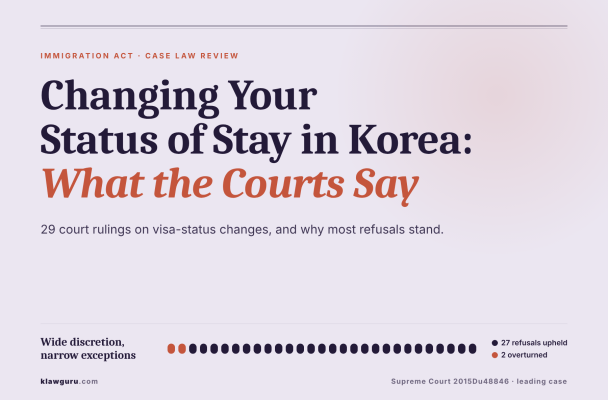
Taken together, these rulings show that courts consistently recognize the authority’s broad discretion across changes of status, grants of status and extensions of the period of stay.
- When plaintiffs won: only where the authority made a mistake of fact (Supreme Court 2015Du48846; Daegu District Court 2011GuHap2394), or clearly violated the principles of proportionality or equality.
- Internal guidelines: decisions made under Ministry of Justice internal guidelines (discretionary standards) are treated as lawful unless the guideline violates the Constitution or the law, or is objectively unreasonable.
- Short-term visitors: for people who entered on short-term visit (C-3) status, a change of status within Korea is treated as subject to refusal in principle.
Thank you for reading.


Leave a Reply