Drug Couriers and Go-Betweens: Key Court Rulings in South Korea
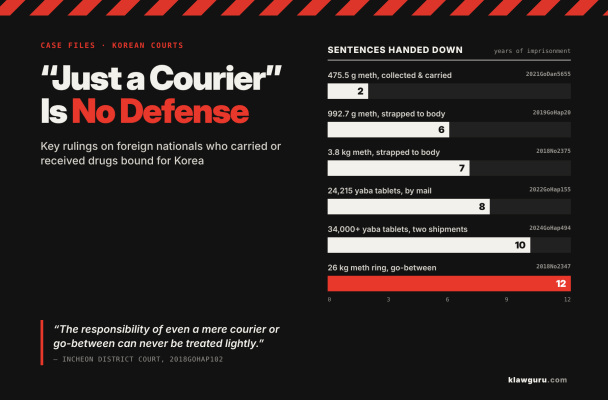
1. Overview: what the cases involving foreign nationals have in common
- the defendants are most often (but not always) foreign nationals from Southeast Asia or Taiwan/China;
- they act on the instructions of an international drug organization; and
- they bring methamphetamine (philopon), yaba and similar drugs into Korea, either concealed on their bodies or by collecting international mail.
The courts consistently hold that even a mere courier or go-between bears serious responsibility. They set the sentence by weighing the quantity of drugs, how significant the defendant’s role was and whether the defendant showed remorse, among other factors.
2. Key rulings
A. Two Taiwanese nationals smuggle about 3.8 kg of methamphetamine
(Incheon District Court Decision 2018GoHap254, 17 August 2018 → partly reversed by Seoul High Court Decision 2018No2375, 13 December 2018)
Facts: Taiwanese Defendants A and B conspired with an unidentified person.
- A’s role: A carried about 3,848.17 g of methamphetamine (street value about KRW 192,400,000) from Taiwan to Korea, vacuum-packed in 8 zip-lock bags and bandaged to his stomach, back, both thighs and both calves.
- B’s role: B boarded the same flight to watch A and guide him to the arranged location.
First-instance sentences: 8 years’ imprisonment each for A and B, with confiscation of the seized methamphetamine.
Appeal result:
- Defendant A: reversed, the appellate court rendered its own judgment (파기자판) of 7 years. The appellate court treated the following as mitigating:
- all the methamphetamine was seized and none was distributed;
- A appears to have been lured by drug organization members with the promise of money, and then joined after threats of harm to himself and his family;
- he had no criminal record in Taiwan or Korea;
- his speech was halting and he appeared to be of slightly below-average intelligence; and
- since B, who had a drug record, travelled with him as a minder, A’s role was lesser than B’s.
- Defendant B: appeal dismissed, 8 years final. The appellate court relied on two aggravating factors:
- B’s role was heavier than A’s: he watched A, entered Korea with him and took him to a hotel as instructed in advance; and
- B had been detained for about 40 days in Taiwan for drug use.
A argued that Article 11(1)1 of the Act on the Aggravated Punishment, etc. of Specific Crimes (value of KRW 50 million or more) should not apply to him. The appellate court rejected this and found dolus eventualis as to the value, based on all of the following together:
- A’s own statement that he had said, “I won’t do it if it’s methamphetamine”;
- the drugs were split across several parts of his body, so he could fully appreciate the quantity; and
- the street value was confirmed at KRW 192.4 million.
| Defendant | First instance | Appeal | Result |
|---|---|---|---|
| A | 8 years | Reversed, 7 years | Reduced by 1 year |
| B | 8 years | Appeal dismissed | 8 years, final |
B. Large-scale methamphetamine smuggling ring: about 26 kg over four trips
(Incheon District Court Decision 2018GoHap283, 17 August 2018 → reversed and rendered by Seoul High Court Decision 2018No2347, 10 January 2019)
Facts: the defendants conspired with a Taiwanese drug supplier to smuggle a total of about 26 kg of methamphetamine on four occasions.
- Defendants B, C, D and E: carried the methamphetamine into Korea concealed on their bodies.
- Defendant A: acted as the go-between. He flew on the same flights as the couriers and collected the smuggled methamphetamine from them.
Appellate ruling: the Seoul High Court held A liable as a co-principal. He knew he was collecting methamphetamine, and had tacitly conspired from Taiwan onward to take on the go-between role. The court found that A’s role was “close to directly and actually distributing methamphetamine imported into Korean territory into society”, and weighed his participation more heavily than a mere courier’s.
Sentences (on appeal):
- Defendant A: 12 years.
- Defendant B: 9 years.
- Defendant C: 8 years.
- Defendants D and E: 7 years each.
C. A Malaysian national smuggles about 992.7 g of methamphetamine
(Incheon District Court Decision 2019GoHap20, 22 March 2019)
Facts: a Malaysian defendant, conspiring with an unidentified person, smuggled about 992.7 g of methamphetamine (street value about KRW 49,635,000) through Gimhae International Airport. The drugs were vacuum-packed in 5 zip-lock bags and bandaged into the defendant’s bra, underwear and both thighs.
Sentence: 6 years’ imprisonment, with confiscation of the seized items.
Mitigating factors:
- the defendant admitted the offense and showed remorse;
- all the methamphetamine was seized and none reached the market;
- the defendant was only a courier; and
- the defendant had no criminal record in Korea.
Aggravating factor: the substantial quantity, about 992.7 g.
Because the value was under KRW 50 million (about KRW 49,635,000), Article 11(1)2 of the Act on the Aggravated Punishment, etc. of Specific Crimes applied, rather than Item 1.
D. A Malaysian national smuggles about 10 kg of methamphetamine
(Incheon District Court Decision 2019GoHap322, 16 August 2019 → reversed and rendered by Seoul High Court Decision 2019No1188, 1963 (consolidated), 9 January 2020)
Facts: a Malaysian defendant conspired with drug-smuggling organization member “B” and with D, E, F, G and others. The scheme worked as follows:
- 12 December 2018: the defendant and E each entered Korea through Gimhae International Airport with about 2.5 kg of methamphetamine hidden on their legs.
- 13 December 2018: F and G brought in about 5 kg by the same method.
- The defendant and E handed their 5 kg to F and G, who hid it in the ceiling of a hotel room.
- D collected it and passed it on.
In total, about 10 kg of methamphetamine (street value about KRW 500 million) was imported.
First-instance sentence: 8 years’ imprisonment and collection of an equivalent value (추징) of KRW 500 million.
How the first-instance court calculated the collection amount: defense counsel argued that the amount should be based only on the 2.5 kg the defendant personally strapped to his body. The court rejected this. Collection of equivalent value under Article 67 of the Narcotics Control Act is a punitive measure, so each accomplice must be ordered to pay the full value of the drugs within the scope each handled. The court therefore ordered collection of KRW 500 million for the entire 10 kg imported under the conspiracy. (Incheon District Court Decision 2019GoHap322, 16 August 2019; Supreme Court Decision 2010Do7251, 26 August 2010)
Appeal result: reversed and rendered to deal with concurrent crimes, 12 years.
The appellate court rejected the defendant’s arguments of factual error and legal error, and upheld the finding that he was a co-principal. However, the offenses in the first-instance judgment (2019GoHap322) and in a second first-instance judgment (a separate case) were concurrent crimes under the first part of Article 37 of the Criminal Act, which required a single sentence. The court therefore reversed both first-instance judgments on its own motion and rendered its own judgment. The 12-year sentence is the result of combining the two cases as concurrent crimes. It is not an increase in the sentence for the single case.
The appellate court gave additional reasons for upholding co-principal liability:
- E testified on appeal that “the man who bandaged us said, ‘When you get to Korea, two more men will bring drugs just like you.'”
- B, the defendant and E had a WeChat group in which B instructed the defendant and E on how to pay for accommodation and hand over the methamphetamine, so the defendant knew B’s instructions through the group chat.
| First instance (2019GoHap322) | Appeal (2019No1188, 1963 consolidated) | |
|---|---|---|
| Reason for reversal | — | Concurrent crimes had to be dealt with together (reversed on the court’s own motion) |
| Co-principal finding | Found | Upheld |
| Collection of equivalent value | KRW 500 million, based on the total conspiracy quantity | Same (KRW 500 million upheld) |
| Sentence | 8 years | 12 years (two cases combined as concurrent crimes) |
| Note | Single case | Consolidated with a separate case |
E. Three Thai nationals import 24,215 yaba tablets
(Cheongju District Court Decision 2022GoHap155, 27 October 2022 → appeal dismissed by Daejeon High Court (Cheongju) Decision 2022No189, 16 February 2023)
Facts: three Thai defendants, at the suggestion of an unidentified person “D” living in Thailand, conspired to receive and pass on 24,215 yaba tablets (street value about KRW 1.2 billion) sent from Laos to Korea by international mail. After importing the yaba, they also used it.
Sentence: 8 years’ imprisonment each.
Appeal: dismissed by the Daejeon High Court (Cheongju), Decision 2022No189, 16 February 2023. The appellate court rejected both the factual-error argument (that the defendants didn’t know the yaba was worth KRW 50 million or more) and the argument that the sentence was excessive.
Notable point: under the proviso to Article 40-2(2) of the Narcotics Control Act, the court exempted the defendants from an order to complete a rehabilitation program (이수명령). Its reason was that, as foreign nationals who couldn’t communicate well in Korean, the program would be of little practical benefit.
F. A Nigerian national carries 475.5 g of methamphetamine
(Seoul Central District Court Decision 2021GoDan5655, 12 January 2022)
Facts: the defendant, a Nigerian national with a pending refugee application, collected and transported 475.5 g of methamphetamine (a 1.7 g sample, 233.3 g and 240.5 g) on a drug dealer’s instructions. The defendant denied carrying drugs or knowing they were drugs. The court convicted, based on all of the following together:
- an accomplice’s statement;
- CCTV footage;
- the defendant’s messages with the dealer; and
- the appearance of the methamphetamine: white crystals plainly visible in clear zip-lock bags.
Sentence: 2 years’ imprisonment. The rehabilitation program order was waived because of difficulty communicating in Korean.
G. Thai nationals import yaba while overstaying their visas
(Cheongju District Court Decision 2024GoHap173, 11 September 2024 → reversed and rendered by Daejeon High Court (Cheongju) 2024No201)
Facts: Thai Defendant A acted as the receiver and Defendant B as the seller, importing yaba from Thailand by international mail. The defendants imported and used the drugs while staying illegally in Korea for a long time after their visas expired.
Appellate ruling: the Daejeon High Court (Cheongju) reversed the first-instance judgment and sentenced A to 5 years and B to 4 years. It took the following into account as mitigating:
- all the yaba was seized and none was distributed in Korea;
- the defendants did not lead the offense;
- they had no criminal record in Korea; and
- they had dependants.
H. A Thai national overstayer smuggles large quantities of yaba twice
(Daejeon District Court Decision 2024GoHap494, 15 November 2024)
Facts: the defendant, a Thai national staying illegally in Korea, conspired with a drug supplier he met on Facebook. He smuggled yaba by international mail on two occasions:
- about 10,000 tablets (street value about KRW 200 million); and
- 24,068 tablets plus 10.34 g (street value about KRW 480 million).
Sharply increasing the quantity on the second shipment, after the first succeeded, counted against him.
Sentence: 10 years’ imprisonment, confiscation, and collection of an equivalent value of KRW 200 million.
3. Common legal principles and sentencing standards
A. When someone is a co-principal
A co-principal requires:
- Subjective element: an intention to commit the crime jointly.
- Objective element: carrying out the crime through functional control over the act, based on that shared intention.
A conspiracy needs no particular legal form. It forms when several people come to a meeting of minds, whether in sequence or tacitly. Co-principal liability can apply even to someone who did not directly take part in carrying out the crime.
However, merely being aware of another’s crime and tolerating it without stopping it is not enough for joint intent. Joint intent means acting as one with a shared intention to commit a specific crime, each using the others’ acts to carry out their own will. (Seoul Central District Court Decision 2016GoHap685, 4 November 2016)
Joining after the crime is complete: drug importation is complete when the drugs enter Korea. Nobody can become a co-principal after that point. (Seoul Southern District Court Decision 2023GoHap113, 11 July 2023)
B. When dolus eventualis is found
Even if the defendant didn’t know for certain that the item was drugs, dolus eventualis is found by considering all the circumstances, such as a high courier fee, a secretive method of transport and how the items strapped to the body felt. Whether the defendant was aware, at least conditionally, that the value was KRW 50 million or more is a separate element from awareness that the item was drugs, and courts assess it strictly. (Daejeon High Court (Cheongju) Decision 2022No189, 16 February 2023)
C. Severe sentencing even for mere couriers and go-betweens
The courts consistently take this position: “A drug organization does not survive on its core members alone. It can keep committing drug crimes and sustain itself only through the cooperation of criminals who share in carrying out the offenses, such as drug couriers and go-betweens. The responsibility of even a mere courier or go-between can never be treated lightly.” (Cheongju District Court Decision 2022GoHap155, 27 October 2022; Gwangju High Court (Jeonju) Decision 2022No208, 8 March 2023; Seoul High Court Decision 2020No1540, 29 October 2020)
D. Collection of equivalent value: nature and scope among accomplices
Confiscation or collection of equivalent value under Article 67 of the Narcotics Control Act:
- The court must order collection of the value even if the offender gained nothing from the crime.
- Where there are several offenders, each must be ordered to pay the full value of the drugs within the scope that person handled.
(Supreme Court Decision 2010Do7251, 26 August 2010; Suwon High Court Decision 2023No1318, 25 April 2024)
E. Exempting foreign defendants from rehabilitation program orders
Under Article 40-2(2) of the Narcotics Control Act, an order to complete a rehabilitation program must, as a rule, be imposed on drug offenders, meaning people who administered, smoked or ingested controlled substances. An exception is allowed where there are special circumstances that prevent it.
Courts often exempt foreign defendants who can’t communicate well in Korean, on the basis that a rehabilitation program is unlikely to help prevent reoffending. (Narcotics Control Act, proviso to Article 40-2(2); Cheongju District Court Decision 2022GoHap155, 27 October 2022; Seoul Central District Court Decision 2021GoDan5655, 12 January 2022)
However, the order can only be imposed on drug offenders who administered, smoked or ingested drugs. A defendant charged only with importing, possessing or selling drugs cannot be given one at all. (Supreme Court Decision 2022Do9737, 17 November 2022; Supreme Court Decision 2024Do17479, 9 January 2025)
F. Sentencing factors
Aggravating factors:
- larger quantities of drugs;
- the drugs reached the market;
- the offense was committed while staying illegally;
- no remorse;
- reoffending; and
- sharply increasing the quantity after a first successful run.
Mitigating factors:
- a role limited to courier or receiver;
- all drugs seized and none distributed;
- admitting the offense and showing remorse;
- no criminal record in Korea;
- having dependants; and
- low risk of reoffending, because deportation is expected after the sentence.
Special points:
- Foreign defendants may be exempted from rehabilitation program orders. This applies only to drug offenders who used drugs, since the order can only be imposed on them.
- Planned deportation is also taken into account.
5. The role of controlled delivery
In many of these cases, investigators used controlled delivery (통제배달). They found the drug parcel during customs clearance, did not seize it on the spot, and let it be delivered under close surveillance so they could arrest the person who collected it.
Controlled delivery has a legal basis in Article 4 of the Act on Special Cases Concerning the Prevention of Illegal Trafficking in Narcotics, etc.
<Foreign Drug Couriers and Receivers: Court Rulings Compared on When Dolus Eventualis and Co-Principal Conspiracy Are, and Aren’t, Found>
1. Legal foundations
A. Requirements for dolus eventualis
Dolus eventualis (미필적 고의, conditional intent) is the state of mind in which a person sees the occurrence of a criminal fact as uncertain but accepts it. Whether the person accepted that possibility doesn’t depend on what they say. It is inferred from their point of view, based on the concrete circumstances: the outward form of their conduct and the situation in which they acted. The court considers how an ordinary person in that situation would have assessed the likelihood of the crime. (Supreme Court Decision 2016Do15470, 12 January 2017)
There is no reason to treat intent for offenses under the Narcotics Control Act differently from intent for other crimes, so the general rules on dolus eventualis apply in the same way.
B. Requirements for conspiracy as co-principals
Co-principals under Article 30 of the Criminal Act require:
- ① Subjective element: an intention to commit the crime jointly.
- ② Objective element: carrying out the crime through functional control over the act, based on that shared intention.
A conspiracy needs no particular legal form. All that’s needed is a meeting of minds between two or more people to jointly commit and bring about a crime. Even without a single planning session covering everything, a conspiracy is formed if the minds of several people come together, whether in sequence or tacitly. (Supreme Court Decision 2002Do6103, 24 January 2003)
However, merely being aware of another’s crime and tolerating it without stopping it is not enough for joint intent. Joint intent means acting as one with a shared intention to commit a specific crime, each using the others’ acts to carry out their own will. (Seoul High Court (Incheon) Decision 2025No335, 28 October 2025)
The line between a co-principal and an accessory (aider) depends on whether the person had functional control over the act. Someone who did not directly carry out any part of the offense is still liable as a conspiring co-principal if, considering everything together, they had functional control by making an essential contribution to the crime. The relevant factors are their position and role in the overall crime and their control or command over how it unfolded.
Joining after completion: once a crime is complete, no one can retroactively become a co-principal in it. This holds even for someone who knows the crime happened and then takes its proceeds, or transports, handles or receives the items that were its object. (Suwon High Court Decision 2024No403, 30 October 2024)
2. Rulings that found dolus eventualis, and the factors used
A. Cases compared
| Case | Defendant | Quantity | Main grounds | Result |
|---|---|---|---|---|
| Incheon Dist. Ct. 2018GoHap102 | Taiwanese juvenile D | About 1,961 g meth | High fee; secretive method of transport; how the items strapped to the body felt; it is unusual to be paid a high fee to secretly carry rubber-like items | Dolus eventualis found |
| Incheon Dist. Ct. 2018GoHap299 | Taiwanese juvenile | About 1.9 kg meth | High fee; secretive instructions; prior courier experience (items carried before looked like drugs) | Dolus eventualis found |
| Incheon Dist. Ct. 2024GoHap1155 | Courier via Canada | About 15.9 kg meth | Excessive pay; client of unknown identity; could have recognized the illegality; financial hardship; prior drug experience (hair and urine positive for cannabis and cocaine; had used ecstasy) | Dolus eventualis found |
| Seoul Central Dist. Ct. 2026GoHap1046 | Courier via the Philippines | About 500 g meth imported + about 826.2 g possessed | Meticulous instructions; high fee; past drug-related conversations; secretive hand-over; knew opening the drug packaging risked airport screening | Dolus eventualis found |
| Seoul Central Dist. Ct. 2025GoHap1285 | Courier via Southeast Asia | About 500 g meth | It accords with common experience to think of drugs when smuggling from Southeast Asia into Korea; claims the items were Viagra or precious metals were rejected | Dolus eventualis found |
B. Analysis by factor
1) High pay
A high courier fee is the single most important circumstantial fact for finding dolus eventualis. The court held that “it is unusual to be paid a high fee to secretly carry rubber-like items.” In other words, an abnormally high fee is in itself a ground for inferring awareness that drugs might be involved. (Incheon District Court Decision 2018GoHap102, 27 July 2018)
In a case where the defendant was paid KRW 3 million per trip, the Seoul High Court found that the defendant knew it was methamphetamine. It held, however, that it was not proven the defendant knew the value was KRW 50 million or more. It therefore applied Article 11(1)2 of the Act on the Aggravated Punishment, etc. of Specific Crimes instead of Item 1. This shows that high pay supports awareness of drugs, but awareness of the value must be assessed separately and strictly. (Seoul High Court Decision 2025No3457, 27 May 2026)
2) How the drugs were carried, and secrecy
Secretive methods of transport, such as hiding drugs on the body, vacuum-packing and strapping them to several parts of the body, are strong circumstantial facts for inferring that the defendant knew the items were illegal. On appeal from Incheon District Court 2018GoHap254, the court held: “A total of 3,848.17 g of methamphetamine, vacuum-packed in several zip-lock bags, was split across several parts of the body, so the defendant could fully appreciate the quantity.” (Seoul High Court Decision 2018No2375, 13 December 2018)
3) Message history (messaging apps and social media)
Chat logs from WeChat, Telegram, Snapchat and similar apps are key evidence of conspiracy and intent.
- Found: in Seoul High Court 2022No3317 and 2023No1020 (consolidated), the defendant had exchanged WeChat messages with “AH” saying “8,000 is 1 kilo.” The court held this showed the defendant could fully have known before the importation that methamphetamine was involved. (Seoul High Court Decision 2022No3317, 2023No1020 (consolidated), 1 June 2023)
- Not found: in the same ruling, defendants AF and AG had only exchanged contact details on 14 March 2022, after the methamphetamine entered Korea. The court held this wasn’t enough to show they were involved before the importation, and found they were not co-principals in it.
4) Past drug experience and record
A defendant’s past drug experience makes them more familiar with drugs and supports a finding of dolus eventualis. In Incheon District Court 2024GoHap1155, the defendant’s hair and urine tested positive for cannabis and cocaine and he had used ecstasy. The court treated him as “a person more familiar with drugs than someone with no drug experience” and relied on this in finding dolus eventualis. (Incheon District Court Decision 2024GoHap1155, 13 February 2025)
3. Ruling that did not find dolus eventualis, and why
A. Example
1) Seoul High Court 2025No3457: awareness of a value of KRW 50 million or more not proven
The court accepted that the defendant knew the item was methamphetamine. It held, however, that it was not proven beyond reasonable doubt that the defendant was aware, even conditionally, that the value was KRW 50 million or more. The court relied on four points:
- the defendant was paid KRW 3 million per trip;
- he had no criminal record;
- he lacked experience handling drugs; and
- he never opened the package.
(Seoul High Court Decision 2025No3457, 27 May 2026)
The case shows that awareness of drugs and awareness of value are separate elements of the offense, and each must be strictly proven.
4. Co-principal conspiracy: rulings compared
A. Conspiracy found
1) Conspiracy before completion + instructions in a WeChat group: found
In Seoul High Court 2019No1188 and 1963 (consolidated), B, the defendant and E had created a WeChat group in which B instructed the defendant and E on how to pay for accommodation and hand over the methamphetamine. The court held that the defendant knew B’s instructions through the group. It found that the conspiracy was formed before F and G’s importation was complete. (Seoul High Court Decision 2019No1188, 1963 (consolidated), 9 January 2020)
2) Functional control: direct involvement in an essential stage of the importation
In Seoul High Court (Incheon) 2025No335, the court found that the defendant had directly taken part in, and carried out, an essential stage of the drug importation. He therefore had functional control over the act, and was a co-principal. (Seoul High Court (Incheon) Decision 2025No335, 28 October 2025)
B. Conspiracy not found
In Seoul High Court 2022No3317 and 2023No1020 (consolidated), there was not enough evidence that defendants AF and AG were involved before the importation. Contact after the drugs entered Korea was not enough to prove a conspiracy before completion, so the court found they were not co-principals in the importation. Joining after completion can raise only a separate form of liability, not co-principal liability. (Seoul High Court Decision 2022No3317, 2023No1020 (consolidated), 1 June 2023)
5. Key factors at a glance
| Factor | Points toward intent / conspiracy | Points away from intent / conspiracy |
|---|---|---|
| Size of pay | Far above normal pay for the work | Small fee; normal level of pay |
| Method of transport | Secretive: hidden on the body, vacuum-packed, split across the body | Ordinary luggage; normal method |
| Client’s identity | Unknown; contact only via social media or messaging apps | An acquaintance whose identity can be confirmed |
| Instructions | Told not to check the contents; secretive hand-over | Contents clearly described; normal work instructions |
| Message history | Drug-related conversations before completion | Contact only after completion; nothing drug-related |
| Past drug experience | Has used or handled drugs | No drug experience |
| Timing of involvement | Conspired before the importation was complete | Joined after completion |
| How essential the role was | Directly involved in an essential stage of the importation | Simply received or passed on; no functional control |
| Awareness of value | High fee + drug-handling experience + opened the packaging, etc. | Small fee; no drug-handling experience; packaging unopened |
6. Practical implications
Challenging dolus eventualis: where a defendant claims not to have known the item was drugs, courts look to the outward circumstances rather than to the defendant’s own account. Defense counsel should therefore concretely prove:
- ① that the fee was normal;
- ② a relationship of trust with the client;
- ③ that the method of transport was normal; and
- ④ that the defendant had no drug experience.
In particular, awareness of value is a separate element from awareness of drugs. When contesting the application of Article 11(1)1 of the Act on the Aggravated Punishment, etc. of Specific Crimes (KRW 50 million or more), it is worth focusing on how much the defendant was paid and the defendant’s lack of drug-handling experience. (Seoul High Court Decision 2025No3457, 27 May 2026)
Co-principal vs. accessory: the key dividing line is whether the receiver or courier joined the conspiracy before the importation was complete. Completion is the point at which the drugs reach the ground, for importation by air. Whether there was a conspiracy before that point should be strictly contested using message history, how roles were divided and whether instructions were received. An accessory’s sentence must be reduced (Criminal Act, Article 32(2)), so whether co-principal liability is found has a direct effect on sentencing.
<Sentencing Foreign Drug Couriers and Receivers in South Korea: Key Factors and Case Analysis>
1. The applicable sentencing guidelines
The guideline most often applied to foreign couriers and receivers is Drug Crimes > 04. Large-Scale Offenses.
- Type 3 or 4: where Article 11(1)1 of the Act on the Aggravated Punishment, etc. of Specific Crimes applies (value of KRW 50 million or more).
- Type 2: where Item 2 applies (value of KRW 5 million or more but less than KRW 50 million).
| Type | Applies when | Recommended range (standard zone) |
|---|---|---|
| Type 2 | Value of KRW 5 million up to KRW 50 million | 5–9 years’ imprisonment |
| Type 3 | Value of KRW 50 million up to KRW 100 million | 8–11 years’ imprisonment |
| Type 4 | Value of KRW 100 million or more | 10–15 years’ imprisonment |
Courts start from the recommended range, but where many mitigating factors are present they often go below the bottom of the range. Under Article 81-6(1) of the Court Organization Act, the sentencing guidelines are a reference to help judges reach a reasonable sentence.
*These guidelines are revised from time to time, so please check here: sc.scourt.go.kr
2. Type, quantity and value of the drugs
A. Why value matters
Article 11 of the Act on the Aggravated Punishment, etc. of Specific Crimes decides whether aggravated punishment applies based on the value of the drugs. The Constitutional Court upheld this value-based aggravation as constitutional, holding:
“Given that drug crimes have the characteristic that the higher the value of the drugs in circulation, the greater the harm to the state and society, the value of the drugs, while not the only measure of the seriousness of the crime, is the most important one.”
(Constitutional Court Decision 2019HeonBa83, 29 April 2021; Constitutional Court Decision 2023HeonBa187, 27 February 2025)
B. Dolus eventualis as to value
Whether the defendant was aware, even conditionally, that the value was KRW 50 million or more is a separate element of the offense and is assessed strictly. The Seoul High Court held:
“The value of drugs is determined by their type and quantity. Where it is proven that the defendant knew the type and quantity of the drugs, it can be found that the defendant was at least conditionally aware of their value, unless special circumstances show the defendant could not have known the objective value at all, or misunderstood it.”
(Seoul High Court Decision 2025No832, 18 September 2025)
C. How quantity and value affect the sentence
The larger the quantity, the more heavily it counts against the defendant. Courts repeatedly stress the danger to society by describing the amount in doses: “so large a quantity that it could be administered more than 6,810 times, based on a single methamphetamine dose of about 0.05 g.” (Incheon District Court Decision 2025GoHap952, 30 October 2025; Incheon District Court Decision 2025GoHap1400, 29 January 2026)
3. Whether the drugs actually reached the market
A. All drugs seized, none distributed: mitigating
That the drugs were all seized and never reached the market is the mitigating factor recognized most consistently in foreign courier cases. Every one of the judgments reviewed expressly takes it into account.
- “The methamphetamine the defendant imported was seized and was not actually used or distributed.” (Incheon District Court Decision 2025GoHap1400, 29 January 2026)
- “The smuggled yaba was seized by investigators and was not distributed in Korea.” (Busan District Court Decision 2022GoHap603, 5 April 2023)
B. Drugs actually distributed: aggravating
Conversely, drugs that actually circulated in Korea are a serious aggravating factor. The Gwangju District Court held:
“Although the quantity cannot be confirmed, the methamphetamine the defendant helped import is presumed to have ultimately been distributed widely within the Thai community. The offense is therefore no less blameworthy than offenses confirmed to involve considerable quantities.”
(Gwangju District Court Decision 2021GoHap334 et al., 28 January 2022)
4. Degree of involvement
A. The basic position on couriers and receivers
Courts consistently hold that even a mere courier or receiver bears serious responsibility, because:
“A drug organization does not survive on its core members alone. It can keep committing drug crimes and sustain itself only through the cooperation of criminals who share in carrying out the offenses, such as drug couriers and go-betweens.”
(Incheon District Court Decision 2025GoHap952, 30 October 2025; Incheon District Court Decision 2025GoHap1400, 29 January 2026)
B. Sentences graded by degree of involvement
Even under the principle that a courier’s responsibility is never light, how heavily the defendant was involved is reflected in the actual sentence.
Heavier involvement (aggravating):
- involvement in the organization’s overall distribution structure;
- a core role, such as recruiting couriers; and
- reoffending with a much larger quantity after a first success.
Lighter involvement (mitigating):
- a role limited to simply receiving or passing on the drugs;
- no general involvement in the overall distribution network; and
- simply carrying out one-to-one instructions from a higher-ranking member.
The Seoul High Court assessed a mere operative’s level of involvement in concrete terms:
“The defendant merely kept and possessed the methamphetamine on one-to-one instructions from his superior. There is no indication that he contacted other members or was involved in the overall distribution structure, so it is difficult to regard this as an ‘organized or professional offense,’ which is a special aggravating factor.”
(Seoul High Court Decision 2024No1353, 25 September 2024)
C. Co-principal vs. accessory
Whether the defendant joined the conspiracy before the importation was complete is the key dividing line between a co-principal and an accessory. An accessory’s sentence must be reduced under Article 32(2) of the Criminal Act, so this assessment directly affects sentencing.
In one case, the defendant received methamphetamine on instructions after its importation was complete. The Seoul Southern District Court found it hard to establish a conspiracy to import. It rejected co-principal liability for the importation and convicted only of receiving the drugs. (Seoul Southern District Court Decision 2023GoHap113, 11 July 2023)
5. Confession and cooperation with investigators
A. What “cooperation” means under the guidelines
“Significant cooperation with the investigation” (중요한 수사협조) is a special mitigating factor under the sentencing guidelines. It is different from a simple confession or general cooperation. The courts have made clear what it means:
“[It] means a case where a drug offender on trial discloses specific and accurate facts about drug crimes to investigators, contributing to the investigation to the extent that those involved are, or can be, prosecuted.”
“Disclosing to investigators a drug crime that the defendant instigated in order to obtain a reduced sentence does not qualify as a mitigating factor.”
(Seoul Central District Court Decision 2019GoDan8453, 11 June 2020; Seoul Central District Court Decision 2019GoDan8450, 3 July 2020)
B. Requirements for significant cooperation
The guidelines define significant cooperation as disclosing specific and accurate facts to investigators, contributing to the extent that those involved are or can be prosecuted, about either of the following, compared with the type of drug offense the defendant is charged with:
- ① a crime of a more serious type; or
- ② a crime of the same type but more serious in nature, for example because it involves many people, or because of its stage, the quantity of drugs, the number of occasions or its duration.
(Jeonju District Court Decision 2025No1856, 14 April 2026; Chuncheon District Court Decision 2024No1378, 18 December 2025)
C. How much cooperation actually reduces the sentence
Where cooperation is recognized, the mitigation zone of the recommended range applies, and the sentence can be cut substantially.
- Seoul High Court 2024No1353: right after his arrest, the defendant revealed where 2,106.5 g of hidden methamphetamine was. He then kept in contact with his superior, which helped investigators seize a further 5,169.4 g, and he helped arrest several members of the organization, including the domestic ringleader and couriers. The guideline mitigation zone (3 years 6 months to 6 years) was applied, and his sentence was cut from 8 years at first instance to 3 years and 6 months. (Seoul High Court Decision 2024No1353, 25 September 2024)
- Busan District Court 2022GoHap603: the defendant’s cooperation made it possible to arrest accomplice B. This was taken into account as mitigating, and a sentence of 5 years, below the bottom of the guideline range, was imposed. (Busan District Court Decision 2022GoHap603, 5 April 2023)
By contrast, where cooperation falls short of “significant cooperation”, it counts only as “general cooperation with the investigation”, a general mitigating factor, and the reduction is limited. (Chuncheon District Court Decision 2024No1378, 18 December 2025)
6. Illegal stay and expected deportation
A. Illegal stay: aggravating
A drug offense committed while staying illegally adds a violation of the Immigration Act as a concurrent crime, and illegal status is itself an aggravating sentencing factor. Courts repeatedly use language such as:
“Having entered the Republic of Korea as a foreign national, the defendant had a duty to obey Korean law and stay in good faith, yet committed a drug crime.”
(Gwangju District Court Decision 2024GoDan3350, 26 November 2024)
The longer the illegal stay, the more heavily it counts. In a case where the defendant bought, possessed, used and sold drugs while staying illegally for about 5 years, the Gwangju District Court, Suncheon Branch, held that “the defendant’s culpability is heavy.” (Gwangju District Court, Suncheon Branch, Decision 2023GoDan1975, 3 April 2024)
B. Expected deportation: mitigating
Where a foreign defendant is expected to be deported after serving the sentence, courts consistently treat the low risk of reoffending in Korea as mitigating. This factor is specific to foreign defendants and doesn’t apply to Korean nationals.
- “As a foreign national, the defendant will be deported after serving the sentence, so the possibility of reoffending in Korea is slim.” (Incheon District Court Decision 2025GoHap1400, 29 January 2026; Incheon District Court Decision 2025GoHap952, 30 October 2025; Incheon District Court Decision 2025GoHap1493, 15 January 2026)
However, this mitigating factor is weighed together with the aggravating factor of offending while staying illegally, and the two can cancel each other out.
C. Exemption from rehabilitation program orders
Courts often exempt foreign defendants who can’t communicate well in Korean from rehabilitation program orders, under the proviso to Article 40-2(2) of the Narcotics Control Act. They reason:
“As a foreign national who has difficulty communicating in Korean, a course order would be of little practical use and unlikely to prevent reoffending, so there are special circumstances that prevent imposing a course order on the defendant.”
(Gwangju District Court Decision 2024GoDan3350, 26 November 2024; Ulsan District Court Decision 2024GoDan1138, 11 June 2024; Seoul Eastern District Court Decision 2022GoDan1066, 6 July 2022)
7. Sentencing factors at a glance
| Factor | Mitigating | Aggravating |
|---|---|---|
| Type and quantity of drugs | Relatively small quantity; value under KRW 50 million | Large quantity; value of KRW 50 million or more; many potential doses |
| Actual distribution | All seized; never reached the market | Actually distributed; widely spread |
| Degree of involvement | Simply received or passed on; not involved in the overall distribution structure; followed one-to-one instructions | Core role; recruited couriers; organized or professional offense |
| Confession and remorse | Admitted the offense; sincere remorse | Denied the offense; no remorse |
| Cooperation | Significant cooperation (special mitigating factor); general cooperation (general mitigating factor) | Refused to cooperate; false statements |
| Criminal record | No record in Korea; no prior offenses of the same kind | Prior offenses of the same kind; repeat offender; reoffending while on a suspended sentence |
| Illegal stay | — | Offending while staying illegally; long illegal stay |
| Expected deportation | Deportation expected after sentence; slim chance of reoffending in Korea | — |
| Dependants | Has family to support | — |
| Rehabilitation program order | May be waived for inability to communicate in Korean | — |
8. Practical implications
For a foreign courier or receiver to get a sentence below the bottom of the guideline range, it’s key to concretely prove these five factors:
- all the drugs were seized and none were distributed;
- the defendant only received or passed on the drugs;
- the defendant admitted the offense and shows sincere remorse;
- the defendant has no criminal record in Korea; and
- because deportation is expected, the risk of reoffending is slim.
On cooperation in particular, what decides the sentence is whether it goes beyond a simple confession or general statement and amounts to “significant cooperation”: real help in arresting higher-ranking members or seizing more drugs. Seoul High Court 2024No1353, where an 8-year sentence was cut to 3 years and 6 months, shows clearly how much active cooperation can affect the sentence. (Seoul High Court Decision 2024No1353, 25 September 2024)
Thank you for reading.


Leave a Reply