AI-Assisted (National) Exam Cheating Under Korean Law
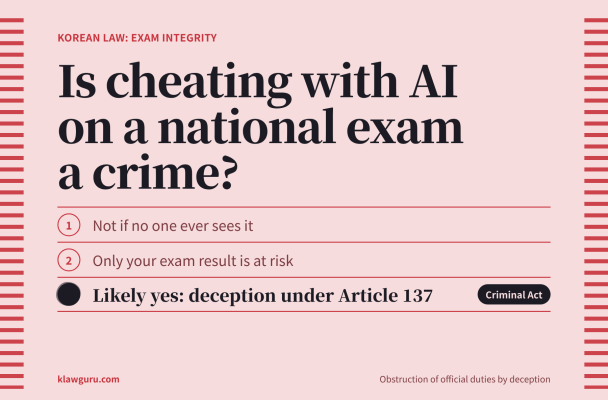
1. How Courts Currently Charge Cheating on National Examinations
A. Obstruction of Performance of Official Duties by Deception (Criminal Act, Article 137): The Core Provision
- Criminal punishment: Under Article 137 of the Criminal Act (형법), the offense is punishable by imprisonment of up to 5 years or a criminal fine of up to KRW 10 million.
- Statute of limitations: Under the Criminal Procedure Act (형사소송법), the statute of limitations for this offense is 7 years.
It is the settled position of the courts to charge cheating on examinations administered by state agencies (e.g., the Certified Tax Accountant Exam, the driver’s license test, the Test of Proficiency in Korean, and national technical qualification exams) under Article 137 of the Criminal Act (obstruction of performance of official duties by deception).
Meaning of “deception” (위계): The Supreme Court defines “deception” as “causing another person to be mistaken, misled, or kept ignorant in order to achieve one’s purpose, and exploiting that mistake, misperception, or ignorance.” It has held that the offense is established only where the other party, as a result, performs an erroneous act or disposition (Supreme Court Decision 2017Do2583, decided April 27, 2017; Supreme Court Decision 2013Do13217, decided February 26, 2015).
Put simply, deception means causing the exam proctor to believe that “this person is taking the exam in the normal manner,” thereby obstructing the proctor’s duty to administer the exam fairly.
The key element: “concrete and actual obstruction of the performance of official duties.” Merely evading the proctor’s eyes is not enough. The offense is established where the conduct reaches the point that the public official would have failed to detect it even while conducting sufficient monitoring and enforcement in accordance with the relevant statutes (Supreme Court Decision 2007Do8024, decided April 15, 2010; Supreme Court Decision 2009Do10659, decided January 14, 2010). Conversely, if the cheating resulted merely from the proctor’s inadequate monitoring, the offense is not established.
B. Recent Decisions
The table below summarizes recent decisions.
| Decision | Type of Cheating | Result |
|---|---|---|
| Suwon District Court, March 14, 2025, 2023Godan5360 | Proxy test-taking in the Test of Proficiency in Korean; unlawful use of an alien registration card | 6 months’ imprisonment, suspended for 2 years |
| Ulsan District Court, April 19, 2023, 2022Godan3895 | During a hazardous materials craftsman exam, sent questions to and received answers from a KakaoTalk group chat on a mobile phone | Criminal Fine of KRW 3 million |
| Ulsan District Court, June 21, 2018, 2018Godan638 | Leaked electrical master craftsman exam questions and shared answers with hundreds of people via KakaoTalk and Google Drive | 6 months’ imprisonment, etc. |
| Jeju District Court, May 25, 2016, 2016Godan615 | Cheating with a wireless device (earphone) during the tourist interpreter guide exam | 8 months’ imprisonment, suspended for 2 years |
| Busan District Court, October 19, 2017, 2017No3031 | Cheating via video call during a driver’s license written test | Criminal Fine of KRW 3 million (reduced on appeal) |
| Seoul Northern District Court, August 30, 2019, 2019Gojeong1005 | Looking at notes written on the palm during a driver’s license written test | Criminal Fine of KRW 500,000, sentence deferred |
| Suwon District Court, November 20, 2020, 2020Godan5579 | Using a notebook during a driver’s license written test | Criminal Fine of KRW 3 million |
As shown, the courts have applied Article 137 of the Criminal Act to a wide variety of cheating methods, including palm notes, cheat sheets, mobile phones, wireless earphones, video calls, proxy test-taking, and leaking of exam questions.
C. Where the Administering Body Is a Private Entity: Obstruction of Business (Criminal Act, Article 314) – punishable by imprisonment of up to 5 years or a criminal fine of up to KRW 15 million.
Where the body administering the exam is not a state agency (e.g., a private school or a private company), obstruction of business by deception under Article 314 of the Criminal Act applies (e.g. LEET). The courts’ position is that proxy test-taking and the use of cheat sheets constitute obstruction of business, and the Suwon District Court, in Decision 2013No5645 (February 12, 2014), also applied obstruction of business to cheating on a private mock exam.
2. Forecast: Possibility of Punishment for AI-Assisted Cheating
A. Possibility of Obstruction of Performance of Official Duties by Deception (Criminal Act, Article 137)
For AI-assisted cheating to be punished under Article 137, two requirements must be met.
① Existence of deception: There must be an act that causes the exam proctor to believe the examinee is taking the exam normally. Concealing an AI device, or receiving AI responses through a wearable device such as a smartwatch or earphone, is a typical act of deception that causes the proctor to be mistaken.
② Concrete and actual obstruction of official duties: This is the key requirement imposed by the Supreme Court. The offense is established where the conduct reaches the point that the public official would have failed to detect it even while conducting sufficient monitoring and enforcement in accordance with the relevant statutes (Supreme Court Decision 2007Do8024, decided April 15, 2010). AI-assisted cheating is far more sophisticated than the use of cheat sheets or mobile phones and is often difficult for proctors to detect, so this requirement is likely to be met.
In particular, where AI-assisted cheating occurs in an exam administered by a state agency (e.g., the Human Resources Development Service of Korea), such as the Certified Tax Accountant Exam, the likelihood that the offense of obstruction of performance of official duties by deception is established is very high.
B. Violation of the Act on National Technical Qualifications (Article 26)
For national technical qualification exams (e.g., electrical master craftsman, hazardous materials craftsman), the offense of obstructing qualification examinations under Article 26(1)(3) and Article 25-3 of the Act on National Technical Qualifications may be applied in addition to Article 137 of the Criminal Act. In the Ulsan District Court’s Decision 2022Godan3895 (April 19, 2023), both offenses were in fact applied together.
C. Obstruction of Business (Criminal Act, Article 314): Where the Administering Body Is a Private Entity
For LEET (Legal Education Eligibility Test), the administering body, the Korean Association of Law Schools, is an incorporated association, not a state agency. Accordingly, cheating on LEET may be subject to Article 314 of the Criminal Act (obstruction of business) rather than Article 137 (obstruction of performance of official duties by deception). However, because LEET operates as part of a national system for admission to law schools, the result could differ depending on the specific facts.
D. Administrative Sanctions: Invalidation of Passing Results and Suspension of Eligibility to Sit for the Exam
Separately from criminal punishment, where cheating is confirmed, the passing result is invalidated and eligibility to sit for the exam is suspended for a certain period. The Supreme Court has consistently held that “cheating refers collectively to all misconduct relating to an exam that undermines, or is likely to undermine, the fairness of a national examination, and even if it did not affect the pass/fail outcome, it constitutes a ground for invalidating the passing result” (Supreme Court Decision 91Nu3284, decided December 24, 1991; Supreme Court Decision 71Nu180, decided January 31, 1972). In other words, even a top scorer or a perfect score will have the passing result invalidated if cheating is established.
3. Key Issue: The Special Characteristics of AI-Assisted Cheating
What distinguishes AI-assisted cheating from conventional cheating is that the likelihood of detection is extremely low. The Supreme Court requires, as an element of obstruction of performance of official duties by deception, that the conduct reach the point where it would go undetected “even with sufficient monitoring and enforcement by the public official” (Supreme Court Decision 2007Do8024, decided April 15, 2010). AI-assisted cheating satisfies this requirement even more readily, because receiving AI responses through a smartwatch or a micro-earphone is difficult to distinguish from normal test-taking.
At the current stage of mere suspicion, however, evidence that AI was actually used is the crux. An abnormally high score alone is not sufficient to establish cheating; concrete evidence such as traces of device use, communication records, and on-site CCTV footage is required.
4. Summary for the General Public
| Category | Content |
|---|---|
| Cheating on exams administered by state agencies | Criminal Act, Art. 137, obstruction of performance of official duties by deception (imprisonment of up to 5 years or a fine of up to KRW 10 million) |
| Cheating on exams administered by private entities | Criminal Act, Art. 314, obstruction of business (imprisonment of up to 5 years or a fine of up to KRW 15 million) |
| National technical qualification exams | Act on National Technical Qualifications, Art. 26, obstruction of qualification examinations, additionally applies |
| Administrative sanctions | Invalidation of passing result + suspension of eligibility to sit for the exam for several years |
| AI-assisted cheating | The above provisions apply as they are; because detection is harder, the deception requirement is in fact easier to satisfy |
The offense of obstruction of performance of official duties by deception, as referred to in the media, is the core provision applied to cheating on exams administered by state agencies, and that reference is accurate and consistent with settled case law. New forms of cheating involving AI can also be fully punished within this legal framework, and in light of the fact that the sophistication of AI technology may make the deception requirement easier to satisfy, the likelihood of punishment is predicted to be high.
RE: Cheating on the College Scholastic Ability Tests (CSAT)
1. Administrative Sanctions: The Primary Response to CSAT Cheating
A. Legal Basis and Procedure
The primary sanction for cheating on the CSAT is an administrative disposition, not criminal punishment. Article 34(5) of the Higher Education Act provides that “a person who engages in cheating in an examination under paragraph (3) shall have that examination invalidated and shall be suspended from eligibility to sit for the examination for one year in the year following the year in which the examination was administered” (Higher Education Act, Article 34(5)).
This disposition is a binding (non-discretionary) act. The Seoul Administrative Court expressly held that “where cheating on the CSAT is established, the defendant is bound by Article 34(4) of the former Higher Education Act and is obliged to invalidate the CSAT score, and has no discretion to impose a different disposition by weighing the public interest against private interests” (Seoul Administrative Court, Decision 2006Guhap6437, decided November 29, 2006). In other words, once cheating is established, the Minister of Education must invalidate the score, with no room for discretion.
The procedure for handling CSAT cheating proceeds in the following order: (1) detection by an on-site proctor; (2) deliberation by the CSAT Cheating Review Committee (within one month of the date of detection); and (3) notification of the result.
B. The Invalidation of a CSAT Score as an Administrative Disposition
The invalidation of a CSAT score is an administrative disposition that may be challenged in an administrative appeal litigation. The Seoul Administrative Court held that “the Minister of Education’s act of invalidating the CSAT score of an examinee who engaged in cheating constitutes an administrative disposition, in the nature of a quasi-legal administrative act (an act of confirmation) that authoritatively determines whether cheating occurred in connection with taking the CSAT and confirms the invalidity of the score resulting from the examination” (Seoul Administrative Court, Decision 2006Guhap6437, decided November 29, 2006). Accordingly, an examinee who disputes a cheating disposition may bring an administrative action (an action for annulment or an action for confirmation of nullity).
C. Types of Cheating
The Regulations on the Handling of Cheaters in the College Scholastic Ability Test (a Ministry of Education directive) specifically enumerate the types of cheating. The principal types at issue in the case law are as follows.
| Type of Cheating | Related Decisions |
|---|---|
| Writing answers after the exam-end announcement | Seoul Administrative Court, Decision 2017Guhap86262, decided March 8, 2018; Seoul Administrative Court, Decision 2021Guhap57582, decided November 26, 2021 |
| Possessing a prohibited item (mobile phone) at the exam site | Seoul Administrative Court, Decision 2016Guhap82416, decided January 20, 2017 |
| Commissioning or carrying out proxy test-taking | Seoul Central District Court, Decision 2020Godan4811, decided January 7, 2021 |
In particular, regarding the mere possession of a mobile phone, the court held that a rule treating the bringing of the device into the exam site as cheating, regardless of whether it was actually used or whether there was intent, does not violate the principle of proportionality, reasoning that “it is impossible to foresee in what forms cheating using electronic devices at the exam site may take place, owing to advances in technology and the like” (Seoul Administrative Court, Decision 2016Guhap82416, decided January 20, 2017). By the same logic, bringing in new types of electronic devices, such as AI devices or smartwatches, may itself constitute cheating.
2. Likely Criminal Punishment: Obstruction of Performance of Official Duties by Deception + Obstruction of Business…
Because the CSAT is a national examination administered by the Minister of Education, cheating on it may be punishable under Article 137 of the Criminal Act (obstruction of performance of official duties by deception). For example: In a proxy test-taking case, the court found obstruction of performance of official duties by deception, obstruction of business (the university’s admissions assessment work), unlawful use of official documents, and trespass on a structure, and imposed a sentence of one year’s imprisonment (Seoul Central District Court, Decision 2020Godan4811, decided January 7, 2021; Seoul Central District Court, Decision 2021No75, decided April 14, 2021, appeal dismissed). The court expressly cited as aggravating circumstances that “proxy test-taking, the most extreme form of cheating, was committed in the CSAT, in which objectivity and fairness are paramount; that it is highly likely to have caused harm to other examinees; and that the commission of such a crime has greatly undermined trust in nationwide examinations” (Seoul Central District Court, Decision 2021No75, decided April 14, 2021).
3. Where Cheating Is Discovered After Admission: Cancellation of Admission and Revocation of Degree
A. The Effect of Cheating, Regardless of Whether It Affected the Pass/Fail Outcome
Cheating is a ground for invalidating a passing result regardless of whether it affected the pass/fail outcome (Suwon District Court, Decision 2007Gahap24629, decided January 11, 2008). Furthermore, where cheating is discovered after a person has entered a university on the strength of a CSAT score obtained through cheating, the university may cancel the admission and revoke the graduation and degree. The Gwangju District Court held that “where a person took the CSAT, was admitted to a university through its early admission track on the basis of the resulting score, completed the academic program, graduated, and was awarded a bachelor’s degree, the act of cancelling that person’s admission and graduation and revoking the bachelor’s degree on the ground that the score was invalidated due to CSAT cheating did not exceed or abuse discretion” (Gwangju District Court, Decision 2008Gahap8081, decided January 22, 2009).
B. Equating a Third Party’s Cheating with the Examinee’s Own: Cheating by Another Person
Even where the examinee did not personally engage in cheating, if a person in a close relationship with the examinee cheated on the examinee’s behalf, the examinee may also be equated with a cheater. For this to apply, however, there must be a close family relationship, such as that between parent and child, between the person who cheated and the examinee; or the cheating must at least be regarded as having taken place within the examinee’s sphere of control; or there must be other special circumstances that justify attributing responsibility for the other person’s cheating to the examinee personally (Suwon District Court, Decision 2007Gahap24841, decided January 11, 2008). On the other hand, there is a case in which the examinee could not be equated with a cheater merely because the examinee had come across leaked questions at a cram school, and the rescission of the pass decision was held void (Suwon District Court, Decision 2007Gahap24841, decided January 11, 2008).
C. Limits: Deviation from or Abuse of Discretion
A cancellation of admission is a discretionary act, so a disposition that clearly deviates from or abuses discretion is unlawful. In a case involving the use of papers with improper authorship attribution in the admissions process, the Gwangju High Court (Jeonju) held that cancelling the admission of a plaintiff who had graduated more than four years after entering the university violated the principle of proportionality and was an unlawful deviation from or abuse of discretion (Gwangju High Court (Jeonju), Decision 2023Nu1472, decided November 29, 2023). In this way, whether discretion was exceeded or abused is determined by comprehensively considering the seriousness of the cheating, its effect on the pass/fail outcome, the degree of disadvantage caused by the disposition, and similar factors.
4. Special Issues in AI-Assisted Cheating on the CSAT
Where AI-assisted cheating occurs on the CSAT, the legal principles analyzed above apply as they are. The following points deserve particular attention.
① Administrative disposition: Devices connected to AI, such as smartwatches and micro-earphones, are prohibited items at the CSAT, so the examination may be invalidated on the basis of bringing them in alone, regardless of whether they were actually used or whether there was intent. The court has already held that such uniform treatment does not violate the principle of proportionality, reasoning that “it is impossible to foresee in what forms cheating using electronic devices at the exam site may take place, owing to advances in technology and the like” (Seoul Administrative Court, Decision 2016Guhap82416, decided January 20, 2017).
② Criminal punishment: Receiving answers through an AI device constitutes a sophisticated form of deception that is difficult for proctors to detect even with sufficient monitoring and enforcement, so it is highly likely to satisfy the elements of obstruction of performance of official duties by deception.
③ Evidence: At the current stage of mere suspicion, concrete evidence that AI was actually used (traces of device use, communication records, analysis of answer patterns, and the like) is the crux, and an abnormally high score alone is insufficient to establish cheating.
Thank you for reading.


Leave a Reply