Bringing Prescription Medication and CBD into South Korea: A Guide for Foreigners (2026)
I. When Prescription Drugs and CBD Become a Crime
1. Basic principle: Korean drug laws apply regardless of the law of the country of departure
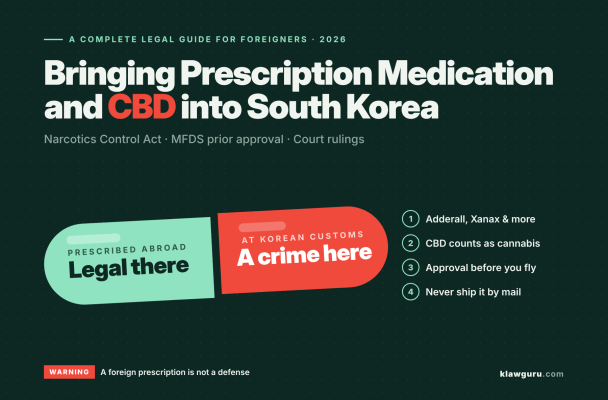
The most important point is this. If a drug counts as a controlled substance under Korean law, bringing it into Korea is a crime in itself, even if it was lawfully prescribed or bought abroad.
- Cannabis: Article 3, Item 7 of the Narcotics Control Act provides that no person may export, import, manufacture, buy or sell cannabis.
- Narcotics and psychotropic substances: Article 4(1)1 provides that no person other than an authorized narcotics handler may import narcotics or psychotropic substances.
The crime of importation is complete the moment the controlled substance is brought from the aircraft or vessel onto land. In other words, the offense is already complete once the substance is off the aircraft and on land, even before it passes through customs at Incheon Airport. (Supreme Court Decision 98Do2734, 27 November 1998, Violation of the Psychotropic Substances Control Act; Supreme Court Decision 98Do4560, 13 April 1999, Violation of the Cannabis Control Act)
2. Bringing in prescription drugs from abroad
2-1. Which drugs are a problem?
Some drugs that foreign nationals are commonly prescribed abroad are designated as psychotropic substances in South Korea.
| Drug | Active ingredient | Classification in Korea |
|---|---|---|
| Adderall | Amphetamine | Psychotropic substance, Category Na (나) |
| Xanax | Alprazolam | Psychotropic substance, Category Ra (라) |
| Penid | Methylphenidate | Psychotropic substance, Category Na (나) |
| LSD | Lysergic acid diethylamide | Psychotropic substance, Category Ga (가) |
| Yaba | Methamphetamine + caffeine mixture | Psychotropic substance, Category Na (나) |
(Narcotics Control Act, Article 2, Item 3; Enforcement Decree, Article 2(3), Appended Tables 3–7)
2-2. Can I be punished even with a prescription?
Yes. As a rule, having a prescription doesn’t protect you. The Act prohibits anyone who is not an authorized narcotics handler from importing psychotropic substances, and a prescription from a foreign doctor does not meet Korea’s import authorization requirements.
There is one exception. A person who is not an authorized handler may handle controlled substances with the approval of the Minister of Food and Drug Safety. (Narcotics Control Act, Article 4(2)7) Anyone who wants to carry narcotics or psychotropic substances when entering or leaving Korea for their own medical treatment must obtain prior approval from the Minister under Article 5(1)6 of the Enforcement Rule. (Enforcement Rule of the Narcotics Control Act, Article 5)
Bringing these drugs in without prior approval makes you liable to punishment.
2-3. Related rulings
① Importing Adderall and Xanax: 2 years 6 months’ imprisonment, suspended for 3 years
The defendant was prescribed Adderall (amphetamine) and Xanax (alprazolam) through a telemedicine service in the United States and had them sent to Korea by international parcel through an aunt. The court took into account, in mitigation, that the drugs were prescribed by a doctor for treatment and brought in for personal use. It nonetheless confirmed that importing psychotropic substances is a crime in itself for anyone who is not an authorized handler, and found the defendant guilty. (Incheon District Court Decision 2022GoHap697, 4 May 2023, Violation of the Narcotics Control Act (Psychotropic Substances))
② Smuggling methylphenidate (Penid): 2 years 6 months’ imprisonment, suspended for 3 years
The defendant had been prescribed methylphenidate at a Korean hospital. When it became difficult to get further prescriptions, they smuggled the drug in from abroad. The court considered that it was for treatment and that this was a first offense, but found the defendant guilty. (Suwon District Court, Ansan Branch, Decision 2013GoHap230, 11 October 2013, Violation of the Narcotics Control Act (Psychotropic Substances))
3. Bringing in CBD products
3-1. CBD counts as cannabis in Korea
Cannabidiol (CBD) is sold legally in many countries as a dietary supplement or medicine. In Korea, however, CBD counts as cannabis under the Narcotics Control Act.
- The Act: Article 2, Item 4(c) defines cannabis to include chemical synthetics identical to the cannabis plant or its resin, as specified by Presidential Decree.
- The Enforcement Decree: Article 2(4), Appended Table 7-2, lists cannabidiol (CBD), cannabinol (CBN), tetrahydrocannabinol (THC) and others as chemical synthetics that count as cannabis.
(Narcotics Control Act, Article 2, Item 4(c); Enforcement Decree, Article 2(4))
In a 2025 ruling, the Supreme Court also clearly confirmed that “under the narcotics control legislation, CBD in itself constitutes ‘cannabis’.” (Supreme Court Decision 2022Du60776, 29 May 2025, Revocation of Refusal to Issue Standard Customs Clearance Report)
3-2. What about hemp seed oil?
The seeds and roots of the cannabis plant, and the mature stalks and products made from them, are excluded from the definition of cannabis. (Narcotics Control Act, proviso to Article 2, Item 4) Pure hemp seed oil extracted from cannabis seeds is therefore, in principle, not cannabis.
However, a product that contains CBD, CBN, CBG, THC or similar compounds does count as cannabis. Even if the label says “Hemp Seed Oil”, bringing it in violates the Act if it contains CBD or similar compounds.
3-3. Am I safe if I didn’t know?
The crime of importing controlled substances requires intent. A defendant who did not realize the item was a controlled substance may be acquitted. Courts, however, decide whether there was intent by looking at all the specific circumstances together.
Intent is more likely to be found where:
- the product’s ingredient list clearly states CBD, THC or similar;
- the person knew that importing cannabis is prohibited in Korea;
- the person has previously been caught or punished for similar products; or
- the product was concealed or declared under a false description.
Intent may be denied where:
- the labeling is ambiguous enough that an ordinary person could mistake it for a legal product;
- the person ordered a small quantity, for treatment, of a product they had used lawfully in their country of residence; or
- the seller’s website gave no warning that the product may not be brought into Korea.
3-4. Related rulings
① Importing CBD capsules: not guilty (no intent)
During a short stay in Korea, the defendant ordered a single bottle of CBD capsules that they had used lawfully in Australia to treat atopic dermatitis. The court noted three points:
- The label displayed “Organic Virgin Hemp Seed Oil” in bold as the main ingredient, with CBD shown in small print.
- Similar products were being sold legally online in Korea.
- It was quite possible the defendant did not realize the product was cannabis, which is prohibited from import.
The court acquitted the defendant, and the appellate court upheld the acquittal. (Busan High Court Decision 2025No35, 21 August 2025, Violation of the Narcotics Control Act (Cannabis))
② Importing CBD oil: guilty (dolus eventualis), 2 years 6 months’ imprisonment, suspended for 3 years
A company’s CEO had CBD oil samples brought from the company’s Japanese branch to its Korean head office. The court found dolus eventualis (willful blindness / conditional intent), because the defendant had approved the product’s launch and knew it contained CBD. In mitigation, the court considered that the samples were for reviewing domestic sales and that all of them were seized before any were distributed. (Seoul High Court Decision 2022No990, 27 October 2022, Violation of the Narcotics Control Act (Cannabis))
③ Importing hemp seed oil: not guilty under the Narcotics Control Act, guilty under the Food Sanitation Act
The defendant imported hemp seed oil from the United States whose THC and CBD content exceeded the limits set by a Food Sanitation Act notice.
- Narcotics Control Act: not guilty. The appellate court held that hemp seed oil may count as cannabis, but the defendant had no intent to import a controlled substance.
- Food Sanitation Act: guilty, with a fine of KRW 1 million, for importing food that exceeded the limits.
(Seoul High Court Decision 2023No1139, 1 September 2023, Violation of the Narcotics Control Act (Cannabis) [offense found: Violation of the Food Sanitation Act])
4. Penalties
Penalties under the Narcotics Control Act vary greatly with the type of substance and the type of act.
| Offense | Provision | Statutory penalty |
|---|---|---|
| Importing cannabis | Article 58(1)5 | Life imprisonment or imprisonment of 5 years or more |
| Importing Category Ga psychotropic substances | Article 58(1)3 | Life imprisonment or imprisonment of 5 years or more |
| Importing Category Na psychotropic substances | Article 58(1)6 | Life imprisonment or imprisonment of 5 years or more |
| Importing Category Ra psychotropic substances | Article 60(1)3 | Imprisonment of up to 10 years or a fine of up to KRW 100 million |
(Narcotics Control Act, Articles 58 and 60)
Actual sentences are often lower than the statutory penalty. Suspended sentences are common where there are factors such as:
- a first offense;
- a small quantity;
- personal use;
- seizure of the entire quantity; or
- confession and remorse.
Because the statutory penalties are so high, however, even after discretionary mitigation (작량감경) the lowest sentence available is often 2 years and 6 months’ imprisonment.
5. Summary of practical precautions
A foreign national who wants to bring medication into Korea, whether on arrival or while living here, should check the following:
- Check in advance. Ask the Ministry of Food and Drug Safety (MFDS) or the relevant authority whether the drug counts as a controlled substance under the Narcotics Control Act.
- Get prior approval. To carry narcotics or psychotropic substances into Korea for your own treatment, you must get prior approval from the Minister of Food and Drug Safety. (Narcotics Control Act, Article 4(2)7; Enforcement Rule, Article 5)
- Be careful with CBD products. CBD oil, CBN capsules, CBG products and similar items sold legally abroad are classified as cannabis in Korea and may not be brought in. Take particular care with any product labeled “Hemp” or “CBD”.
- A prescription isn’t enough. A prescription from a foreign doctor does not meet Korea’s import authorization requirements. Even with a prescription, you can be punished for bringing the drug in without prior approval.
- “I didn’t know” has limits. A lack-of-knowledge defense is sometimes accepted, but courts look at whether you checked the ingredient list, any warnings on the seller’s website, your background knowledge and similar factors. Simply saying “I thought it was legal” does not guarantee an acquittal.
II. How to Get MFDS Approval to Carry Medication
1. Legal basis and overview
As a rule, anyone who is not an authorized narcotics handler may not import narcotics or psychotropic substances. As an exception, handling is permitted with the approval of the Minister of Food and Drug Safety, as set out by Ordinance of the Prime Minister. (Act on the Control of Narcotics, etc. (“Narcotics Control Act”), Article 4(1) and 4(2)7)
One of these listed exceptions is carrying narcotics or psychotropic substances when entering or leaving Korea for personal medical treatment. (Enforcement Rule of the Narcotics Control Act, Article 5(1)6)
For cannabis, an amendment to the Enforcement Decree that took effect on 9 December 2022 created a basis for approval to carry cannabis as a medicine for personal treatment when entering or leaving South Korea. (Enforcement Decree of the Narcotics Control Act, Article 3(3)5)
2. Approval procedure
A. When to apply
Approval must be obtained before entering or leaving Korea.
The Seoul High Court noted that the defendant could have brought the prescribed medication into Korea through this procedure if needed, but instead carelessly put it in their luggage. This makes clear that the prior approval procedure is both available and required. (Seoul High Court Decision 2023No636, 4 April 2024)
B. Where to apply
Applications go to the Minister of Food and Drug Safety. In practice, they are submitted to the Narcotics Policy Division of the Pharmaceutical Safety Bureau at the Ministry of Food and Drug Safety (MFDS), or through its online portal (의약품안전나라, the “Drug Safety Country” portal).
C. Required documents
The following documents must be attached to the application form (Annex Form No. 3):
| Document | Notes |
|---|---|
| (a) Copy of proof of entry/departure | Flight ticket, passport copy, etc. Can be omitted if you consent to administrative information sharing. |
| (b) Statement of the medication’s name, quantity, length of stay and purpose of travel | Prepared by the applicant |
| (c) Medical certificate issued by a doctor at a Korean or foreign medical institution | Must state the medication name, dose per administration, number of doses per day, total number of days, and directions for use. Arriving travelers may instead submit an export approval issued by the government of the departure country for narcotics or psychotropic medication for personal treatment. |
(Enforcement Rule of the Narcotics Control Act, Article 5(2)2)
The medical certificate must not simply state the name of the condition. It must specify the medication name, dose per administration, doses per day, total number of days and directions for use.
D. Processing time
Current law sets no processing time. MFDS’s official guidance indicates applications are usually processed in about 7 days, but this is not fixed by law, so apply well before you travel. It may take longer if the supplying country has its own export approval process.
E. Approved quantity
Current law sets no maximum quantity. In practice, approval is based on the minimum amount needed for treatment during your stay. The amount is calculated from the daily dose and total number of days on the medical certificate, and as a rule, quantities beyond the length of stay are not approved.
F. After approval
Even with approval, you must declare the medication to customs on arrival.
Article 57-2 of the Narcotics Control Act exempts people approved to carry narcotics or psychotropic substances for personal treatment from certain provisions (Articles 11, 15 and 44). As a result, some of the management obligations that apply to ordinary narcotics handlers don’t apply. (Narcotics Control Act, Article 57-2, Item 1)
3. Carrying in person vs. sending by mail or courier (international parcels)
A. Key differences
The law treats carrying medication in person and sending it by mail or courier completely differently.
| Carried in person | Sent by mail/courier | |
|---|---|---|
| Legal basis | Enforcement Rule, Article 5(1)6 | None (treated as ordinary importation) |
| Who can bring it in | Approved by the Minister of Food and Drug Safety | Licensed narcotics importers/exporters only |
| Available to individuals? | Yes, with prior approval | No |
| Penalty for violation | Violation of the Narcotics Control Act | Violation of the Narcotics Control Act |
B. Why mail and courier aren’t allowed
Article 5(1)6 of the Enforcement Rule only covers cases of “carrying [the medication] when entering or leaving the country.” Importing by international mail or courier falls outside this provision.
Only licensed narcotics importers/exporters may import narcotics or psychotropic substances by mail or courier. An individual who does so violates Article 4(1) of the Narcotics Control Act. (Narcotics Control Act, Article 18(1) and Article 4(1))
Compare two real cases:
- Sent by international parcel: a defendant had amphetamine prescribed in the US sent to Korea by international parcel through an aunt. The court considered the treatment purpose but convicted them.
- Carried in person: a person entered Korea carrying amphetamine for ADHD treatment, together with the prescription. They received a suspension of indictment (기소유예).
The different outcomes show that, in practice, whether the medication was carried in person is an important dividing line. (Incheon District Court Decision 2022GuDan50561, 18 November 2022 vs. Incheon District Court 2022GoHap697)
C. Exception where no alternative treatment exists in Korea
This is separate from mail or courier importation. Where no alternative treatment is available in Korea, a person may, with separate approval, handle narcotics or psychotropic substances for personal treatment that were imported through the Korea Orphan & Essential Drug Center. (Enforcement Rule, Article 5(1)6-2)
In this case, you must submit:
- a medical certificate from a specialist in the relevant condition at a Korean medical institution;
- medical records; and
- a medical opinion stating that no alternative treatment exists in Korea.
(Enforcement Rule, Article 5(2)2-2)
4. Summary of practical points
- Prior approval is mandatory. Approval after arrival isn’t recognized, and bringing medication in without prior approval is punishable even if it’s for treatment.
- The medical certificate must be specific. It must state the medication name, dose per administration, doses per day, total number of days and directions for use.
- Quantity is limited to the minimum needed for treatment during your stay.
- Mail and courier are not allowed. The personal-treatment exception only applies when you carry the medication yourself when entering or leaving Korea.
- Declare at customs even with approval. Bringing it in without declaring it can cause separate problems.
- Allow time for processing. The law sets no processing time, so it’s safest to apply at least 2–3 weeks before departure.
III. Who Can Apply, Where and How Long It Takes
1. Who may apply
A. Legal requirements
Article 5(1)6 of the Enforcement Rule of the Act on the Control of Narcotics, etc. (“Narcotics Control Act”) makes “carrying narcotics or psychotropic substances when entering or leaving the country for personal treatment” eligible for approval. The provision places no restriction on the applicant’s nationality or visa status, so foreign nationals can apply on the same terms as Korean nationals. (Enforcement Rule of the Narcotics Control Act, Article 5(1)6)
In substance, however, the following must be met:
- You must not be an authorized narcotics handler. (Narcotics Control Act, Article 4(2)7)
- It must be for personal treatment. Giving the medication to someone else or selling it doesn’t qualify. Courts have also held that administering or supplying to another person a controlled substance that a licensed medical narcotics handler provided for your own use is not handling permitted under Article 4(2)1.
- You must carry it in person. Importing by mail or courier falls outside this provision.
B. Additional requirement for cannabis
For cannabis, Article 3(3)5 of the Enforcement Decree allows approval only where “a patient carries cannabis as a medicine for personal treatment when entering or leaving the country.” (Seoul High Court Decision 2023No636, 4 April 2024)
2. Where and how to apply
A. Receiving authority
The application must be submitted to the Minister of Food and Drug Safety. (Enforcement Rule, main text of Article 5(2))
B. How to submit in practice
Current law doesn’t restrict submission to online or in person. Article 5(2) of the Enforcement Rule allows the application to be submitted “including as an electronic document”, so online submission is permitted.
In practice, the channels are:
| Method | Where |
|---|---|
| Online | Civil petition on the MFDS “Drug Safety Country” portal (nedrug.mfds.go.kr) |
| In person or by post | Narcotics Policy Division, Pharmaceutical Safety Bureau, Ministry of Food and Drug Safety (MFDS) |
The MFDS has not published official guidance on this point. Check the exact online menu path and the division’s contact details directly on the MFDS website (mfds.go.kr) or the Drug Safety Country portal.
3. Processing time
A. No processing time in the law
Neither the Narcotics Control Act nor its Enforcement Decree or Enforcement Rule sets a processing time for approval to carry medication for personal treatment. The MFDS has not published official guidance on this point
B. Duty to publish processing times under the Administrative Procedures Act
Article 19(1) of the Administrative Procedures Act requires administrative agencies to set and publish processing times for each type of matter in advance. MFDS has a duty to publish processing times under the Civil Petitions Treatment Act and the Administrative Procedures Act, but the MFDS has not published official guidance on this point
C. In practice
Because the law fixes no processing time, it’s essential to apply well before departure. The Seoul High Court noted that the defendant could have brought the prescribed medication into Korea through this procedure if needed, but instead carelessly put it in their luggage. This makes clear that the prior approval procedure is both available and required. (Seoul High Court Decision 2023No636, 4 April 2024)
4. Required documents: translating and notarizing a foreign-language medical certificate
A. Documents required by law
Article 5(2)2 of the Enforcement Rule requires:
| Document | Details |
|---|---|
| (a) Copy of proof of entry/departure | Flight ticket, passport copy, etc. Can be omitted if you consent to administrative information sharing. |
| (b) Statement about the medication | Medication name, quantity, length of stay, purpose of travel, etc. |
| (c) Medical certificate or export approval | A medical certificate issued by a doctor at a Korean or foreign medical institution, or, for arriving travelers, an export approval for personal treatment issued by the government of the departure country |
(Enforcement Rule of the Narcotics Control Act, Article 5(2)2)
The medical certificate must be “one that specifies the medication name, dose per administration, number of doses per day, total number of days, directions for use, etc.” This is set out in Annex Form No. 3 under Article 5(2) of the Enforcement Rule.
B. Translation and notarization of foreign-language certificates
Article 5(2)2 of the current Enforcement Rule does not expressly require a translation or notarization for a medical certificate written in a foreign language. This can be confirmed from the text of the provision.
There are practical considerations, however:
- A translation is advisable in practice. MFDS staff must review the contents of a foreign-language certificate, so without a translation you’re likely to be asked for supplementary documents. Even though the law doesn’t require it, attaching a Korean translation is recommended.
- No notarization requirement. The Enforcement Rule does not require notarization or an apostille for the medical certificate. This differs from other procedures, such as real estate registration, that require an apostille on foreign public documents.
- Alternative document for arriving travelers. Instead of a medical certificate, an arriving traveler may submit an export approval for narcotics or psychotropic medication for personal treatment, issued by the departure country’s government. Because this is a foreign government document, notarization or an apostille may be requested in practice, although this isn’t a legal requirement either.
Bottom line: the law doesn’t require translation or notarization. If you submit a foreign-language medical certificate, attaching a Korean translation helps avoid delays in review. Notarization is not legally required.
5. Can someone apply on your behalf?
A. No provision in the law
Article 5(2) of the Enforcement Rule provides for submission by the applicant, but no provision expressly prohibits or permits an application by an agent.
B. General principle under the Administrative Procedures Act
Article 12 of the Administrative Procedures Act provides that applications and similar acts before an administrative agency may be made through an agent. Since the Narcotics Control Act’s Enforcement Rule has no specific provision prohibiting it, an application by an agent is possible under this general principle.
Note the following:
- An agent may in practice be asked to submit a power of attorney and a copy of the agent’s ID.
- The approval applies to the person actually carrying the medication when entering or leaving Korea, so the personal details on the application must be that person’s.
- The MFDS has not published official guidance on this point, so it’s safest to check with MFDS beforehand.
6. Short-term visitors with no address in South Korea
A. No address requirement in the law
Article 5(2)2 of the Enforcement Rule only requires proof of entry/departure, a statement about the medication and a medical certificate. It does not require a Korean address or alien registration. Short-term visitors with no address in Korea are therefore not excluded from applying.
B. How short-term visitors can apply
① Apply online before arrival (recommended)
The safest option is to apply online before you arrive. The Enforcement Rule allows the application to be submitted as an electronic document, so you can apply online while still outside Korea. (Enforcement Rule, main text of Article 5(2))
② Use an export approval as an arriving traveler
An arriving short-term visitor may submit, instead of a medical certificate, an export approval for narcotics or psychotropic medication for personal treatment issued by the government of the departure country. You must first complete that country’s export approval procedure, so check its requirements in advance. (Enforcement Rule, Article 5(2)2(c))
③ Consent to administrative information sharing
A foreign national’s details may not be registered in Korea’s information-sharing system, though, so it’s safer to submit a flight ticket or similar proof directly. (Enforcement Rule, Article 5(2)2(a))
C. Practical tips
Short-term visitors stay only briefly. Enter your actual planned length of stay accurately in the “length of stay” field, and apply only for the minimum quantity needed for treatment during that period. As a rule, quantities beyond the length of stay are not approved.
7. Summary
| Item | Details | Legal basis |
|---|---|---|
| Who may apply | Not an authorized narcotics handler; for personal treatment; carried in person | Enforcement Rule, Article 5(1)6 |
| Receiving authority | Minister of Food and Drug Safety | Enforcement Rule, Article 5(2) |
| How to submit | Online (Drug Safety Country portal), in person or by post | Enforcement Rule, Article 5(2) (electronic documents allowed) |
| Processing time | Not set by law (apply well in advance) | — |
| Translating a foreign-language certificate | Not legally required, but a Korean translation is recommended in practice | Enforcement Rule, Article 5(2)2 |
| Notarization | Not legally required | Enforcement Rule, Article 5(2)2 |
| Application by an agent | Not prohibited by law; general principle of the Administrative Procedures Act applies | Administrative Procedures Act, Article 12 |
| Short-term visitors | No Korean address required; can apply online before arrival | Enforcement Rule, Article 5(2)2 |
Limits of the official information: The MFDS has not published official guidance on this. For practical matters not set out in the law, check directly on the MFDS website (mfds.go.kr) or the Drug Safety Country portal (nedrug.mfds.go.kr), or call the MFDS civil petition helpline (1577-1255). This applies to processing times, the online application menu path and agent application procedures.
IV. Agent Applications and Short-Term Visitors
1. Can an agent apply on your behalf?
A. What the Enforcement Rule covers
Article 5(2) of the Enforcement Rule of the Narcotics Control Act sets out only how to submit the application and which documents to attach. No provision expressly permits or prohibits an application by an agent. The reference materials also don’t show whether the application form (Annex Form No. 3) has a separate field for an agent. (Enforcement Rule of the Act on the Control of Narcotics, etc., Article 5(2))
FYI, the MFDS has not published official guidance on this.
B. The agent system under the Administrative Procedures Act
Because the Enforcement Rule has no specific provision prohibiting agent applications, the general principles of the Administrative Procedures Act apply.
Article 12(1) of the Administrative Procedures Act provides that a party may appoint any of the following as an agent. (Administrative Procedures Act, Article 12(1))
| Item | Who may act as agent |
|---|---|
| Item 1 | The party’s spouse, lineal ascendants or descendants, or siblings |
| Item 2 | If the party is a corporation, etc., its officers or employees |
| Item 3 | An attorney |
| Item 4 | A person authorized by the administrative agency (or by the hearing officer, for hearings only) |
| Item 5 | A person who may act as agent in the matter under applicable laws |
A spouse, lineal ascendant or descendant, sibling or attorney may therefore be appointed without separate authorization. Anyone else, such as a friend or colleague, needs the administrative agency’s authorization to act as agent. (Administrative Procedures Act, Article 12(1)4)
A party who appoints an agent must notify the administrative agency without delay. (Administrative Procedures Act, Article 13(1))
C. Practical limits on agent applications
Even though the Administrative Procedures Act allows agent applications, there are practical limits:
- The approval belongs to you. The personal details on the approval (name, passport number, medication, quantity, length of stay, etc.) must be those of the person who will actually carry the medication into Korea.
- The medical certificate must be in your name. Article 5(2)2(c) of the Enforcement Rule requires “a medical certificate issued by a doctor at a Korean or foreign medical institution”, which means a certificate about the applicant.
- Authorization is discretionary. Where the agent needs the agency’s authorization, MFDS decides at its discretion whether to grant it, so check with MFDS in advance.
2. Power of attorney: format and certification
A. No prescribed form in the law
Article 5(2) of the Enforcement Rule doesn’t set a form or certification requirement for a power of attorney in an agent application. The Administrative Procedures Act doesn’t specify a form or notarization requirement for appointing an agent either.
B. A useful reference: the Enforcement Decree of the Framework Act on Administrative Investigations
Article 5(2)3 of the Enforcement Decree of the Framework Act on Administrative Investigations requires “the applicant’s power of attorney and the agent’s identification” when a voluntary agent is allowed to inspect records, and requires the power of attorney to follow Annex Form No. 4. This provision doesn’t apply directly to narcotics handling approvals. (Enforcement Decree of the Framework Act on Administrative Investigations, Article 5(2)3)
C. In practice
There’s no express legal requirement, but it’s safest to prepare the following:
| Document | Contents |
|---|---|
| Power of attorney | Name and passport number of the principal (you), scope of authority, the agent’s name, date, and the principal’s signature or seal |
| Copy of principal’s ID | Passport copy |
| Copy of agent’s ID | Passport or Korean resident registration card |
Notarization: the Enforcement Rule does not require notarization or an apostille on the power of attorney. If the principal is abroad and can’t easily sign the power of attorney in person, MFDS may ask for additional documents to confirm it’s genuine. Check with MFDS in advance in that case.
3. Applicant’s signature and identity verification
A. Signature requirements
Article 5(2) of the Enforcement Rule allows the application to be submitted “including as an electronic document.” An electronic signature can be used for an electronic application, while a handwritten signature or seal is required for in-person or postal submission.
B. Identity verification
A foreign applicant’s identity is verified with their passport. Article 5(2)2(a) of the Enforcement Rule requires a copy of proof of entry/departure, and a passport copy satisfies this.
Where the necessary details can be confirmed from a certificate issued by an administrative agency that the petitioner holds, such as a passport, the agency may not require separate supporting documents.
For short-term visitors without an alien registration number, the passport number is the basis for identification. No law requires an alien registration number.
4. Contact details and service address for short-term visitors with no Korean address or alien registration number
A. No Korean address requirement
Article 5(2)2 of the Enforcement Rule only requires proof of entry/departure, a statement about the medication and a medical certificate. It does not require a Korean address or an alien registration number. Short-term visitors with no address in Korea are therefore not excluded from applying.
B. Contact details
Short-term visitors can give contact details as follows:
| Situation | What to enter |
|---|---|
| Already in Korea | A temporary Korean contact (accommodation phone number or temporary Korean mobile number) |
| Applying before arrival | Overseas contact details (email address, overseas phone number) |
| Able to receive email | Your email address as the main contact |
Because the Enforcement Rule allows electronic applications, contact by email is possible. Under Article 14(3) of the Administrative Procedures Act, service through an information and communications network is made only with the recipient’s consent. If you consent to receiving documents by email, you can receive the approval by email. (Administrative Procedures Act, Article 14(3))
C. Service address
Article 14(1) of the Administrative Procedures Act provides that service is made to the recipient’s “address, residence, place of business, office or email address.” Short-term visitors can enter a service address as follows. (Administrative Procedures Act, Article 14(1))
① Applying before arrival: enter your overseas address or email address. The Supreme Court has held that documents may be served by post on foreign businesses with no address, residence, place of business or office in Korea, so service by post to an overseas address is also possible. (Supreme Court Decisions 2003Du11155 and 2003Du11124, both 23 March 2006, Confirmation of Nullity of Corrective Orders, etc.)
② Applying after arrival: you can enter the address of where you’re staying (hotel, guesthouse, etc.) as your temporary residence. Article 14(1) recognizes a “residence” as a place of service, so a temporary accommodation address is a valid service address.
③ Consent to email service: the most practical option is to enter an email address and consent to service through an information and communications network. You can then receive the approval without a Korean address.
5. Summary
| Item | Details | Legal basis |
|---|---|---|
| Can an agent apply? | Yes (not prohibited by law; general principle of the Administrative Procedures Act applies) | Administrative Procedures Act, Article 12(1) |
| Who may act as agent | Spouse, lineal ascendants/descendants, siblings and attorneys need no authorization; others need the agency’s authorization | Administrative Procedures Act, Article 12(1), each item |
| Power of attorney form | No prescribed form; principal’s signature and copy of the agent’s ID recommended | Enforcement Rule, Article 5(2) (silent) |
| Notarization of power of attorney | Not legally required | Enforcement Rule, Article 5(2) |
| Identity verification | Passport copy suffices; no alien registration number needed | Civil Petitions Treatment Act, Article 10(1) and (3) |
| Contact details | Overseas phone number or email address may be used | |
| Service address | Overseas address, temporary accommodation address or email address | Administrative Procedures Act, Article 14(1) and (3) |
Limits of the official information: The MFDS has not published official guidance on this. Before applying, check matters not set out in the law directly on the MFDS website (mfds.go.kr) or the Drug Safety Country portal (nedrug.mfds.go.kr), or call the MFDS civil petition helpline (1577-1255). This applies to whether agent applications are accepted, the power of attorney format and the procedure for foreign applicants.
Thank you for reading.


Leave a Reply